Custom Gift Boxes Wholesale: Structures, Finishes, MOQ and Lead Time
Custom gift boxes wholesale: lid-and-base, drawer and magnetic rigid structures compared, with finishes, inserts, MOQ 100, samples and lead times.
Ordering custom gift boxes wholesale is a series of small decisions that together decide both the unboxing and the unit economics: which rigid structure, which wrap and finish, a stock size or a bespoke die, how many pieces, and how the schedule lines up with your launch. Most buyers approach it backwards — choosing a look first and discovering the MOQ, tooling fee or freight profile afterwards. This guide is the hub for that process: it compares the rigid gift box structures we actually produce, explains the materials and logo methods, sets out sizing and insert logic, and gives the MOQ, sample and lead-time rules behind a branded order. Each section links to a deeper, structure-specific guide so you can go as deep as your brief needs.
What counts as a custom gift box?
A custom gift box is a rigid paper-wrapped box produced for one brand, rather than plain counter stock. Customisation happens at three levels, and the level you pick — not the box shape — is what sets the MOQ, tooling and lead time. At logo level, a stock structure in a standard wrap colour is branded with your foil, deboss, UV or print; the cutting dies already exist, so only the logo tooling is made new. At colour level, the same structure is wrapped in a custom-dyed or Pantone-matched paper. At structure level, a new dieline and cutting die create a bespoke size or opening mechanism built around your product. If a stock format fits, staying at logo level is almost always the fastest and least capital-intensive route.
The rigid gift box structures compared
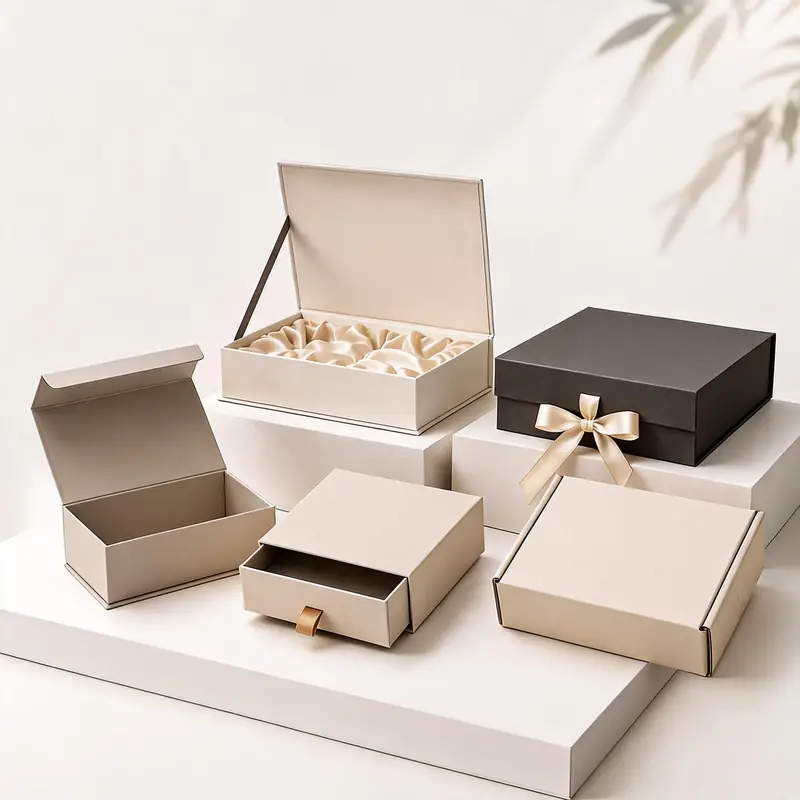
Every rigid gift box in the range starts the same way — greyboard, typically 1.5–2 mm, wrapped in coated, kraft or specialty paper — and differs in how it opens and ships. Four families cover nearly every wholesale brief.
| Structure | Opens by | Ships | Typical fit |
|---|---|---|---|
| Lid-and-base (two-piece) | Lift-off lid over a separate base | Assembled, nested | Jewelry, candles, cosmetics, high-volume gifting |
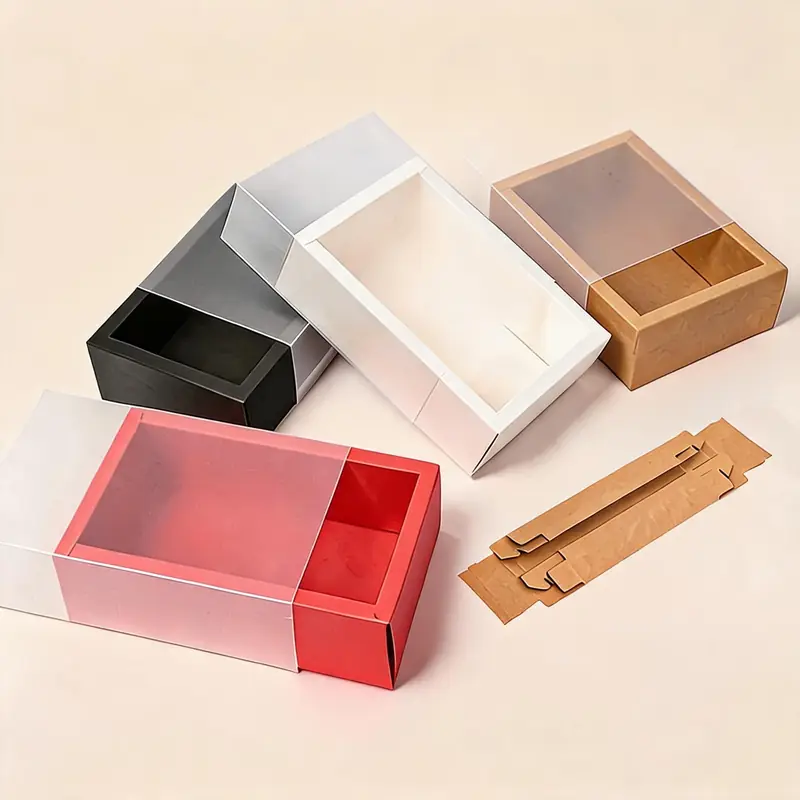
| Drawer (sliding sleeve) | Inner tray slides out; optional window and ribbon pull | Assembled, or flat in the kraft folding line | Jewelry, tea, chocolate, curated sets |
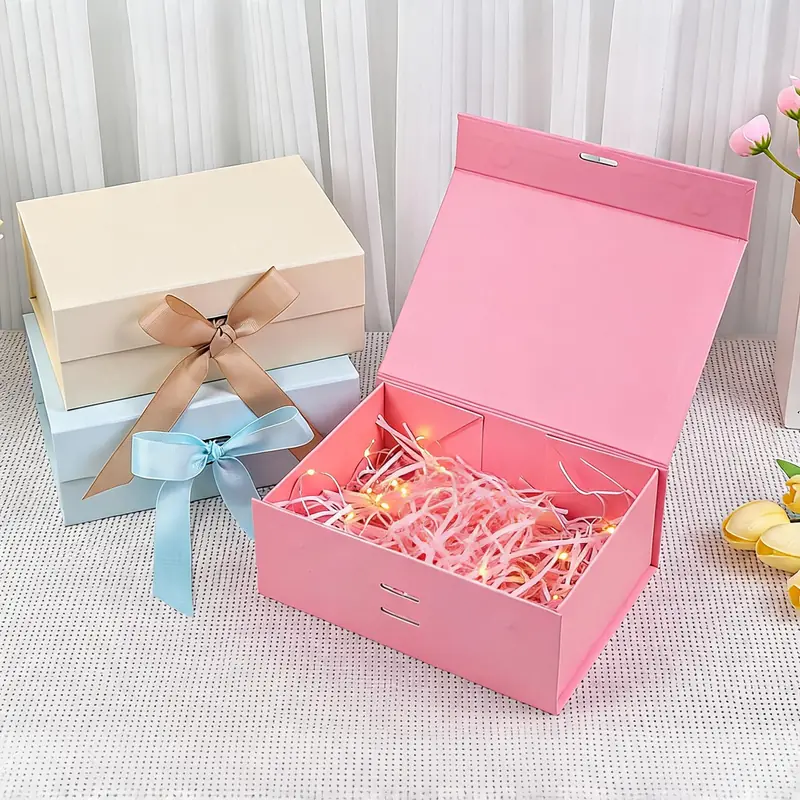
| Foldable magnetic (one-piece) | Hinged flip-top on hidden magnets | Flat as a single blank; folds without glue | Hampers, corporate gifts, apparel, export orders |
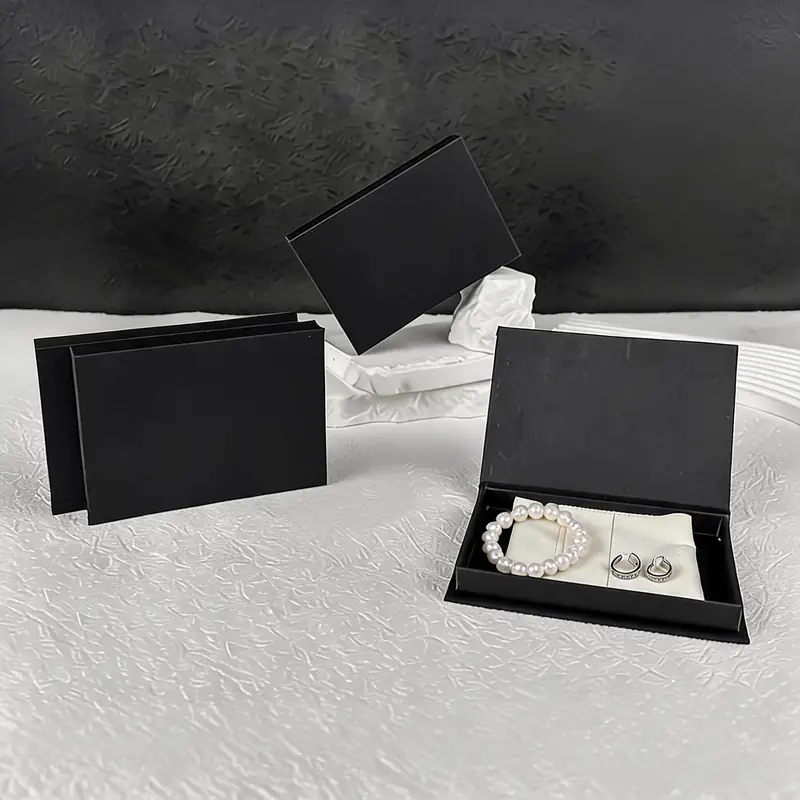
| Book-style magnetic | Book-style hinged lid with a magnetic clasp | Assembled in slim formats | Slim jewelry, electronic accessories, vouchers |
| Window box | Lid-and-base with a clear PVC or PET window panel | Assembled | Bakery, counter retail display, favours |
All five formats share the same greyboard-and-wrap construction; the differences are the opening motion and the freight profile.
The lid-and-base box is the workhorse: the simplest format, the densest when nested for packing, and usually the most economical at volume. The drawer adds a controlled, filmable reveal and a window option. The foldable magnetic is the freight specialist — the same rigid hand-feel with up to 80% less shipping volume — while the book-style format suits slim, flat products. Window boxes exist whenever the product needs to be seen before it is bought.
Rigid vs folding: cost and freight compared
Board weights, assembly labour and the air-freight penalty of shipping assembled set-up boxes are compared line by line in our rigid vs folding guide, including which formats genuinely ship flat.
Read: Rigid vs Folding Gift BoxesDrawer box packaging in depth
If the sliding reveal is on your shortlist, the drawer guide covers sleeve construction, eight stock inner sizes from 8 × 5 × 3 to 30 × 15 × 5 cm, window and card options, and when to pick the flat-folding kraft line.
Read: Custom Cardboard Drawer BoxesChoosing by product and sales channel
- Jewelry and small luxury pieces: a lid-and-base or drawer box, always with a fitted insert. The box sells the set and the insert prevents scratching; windowed drawers suit counter retail where staff present the piece.
- Cosmetics, candles and hampers: the foldable magnetic in M through XL sizes. Rigid presentation supports premium positioning, while flat shipping keeps freight sensible on heavy, volumetric products.
- Corporate and event gifting: one stock structure branded in event colours, with different inserts or filler per gift tier. The foldable magnetic stores flat until the packing team needs it, which matters when hundreds arrive weeks before an event.
- E-commerce and DTC: a folding kraft drawer or foldable magnetic going inside a corrugated mailer. The rigid box creates the unboxing moment; the mailer handles the courier.
The flat-shipping option in depth
The one-piece foldable magnetic box, its five stock sizes, five wrap colours and the 80% freight-volume saving are covered with real dimensions in the magnetic closure guide.
Read: Magnetic Closure Gift Boxes WholesaleBoard, wraps and logo finishes
Rigid boxes are built on 1.5–2 mm greyboard — up to 2.5 mm on large or heavy formats — and wrapped in paper around 157 gsm or a comparable specialty stock. Kraft delivers the natural, recycled look; coated white or black card is the clean corporate base; textured and leather-grain specialty papers carry the luxury tier without any printing at all. Matte lamination is the default wrap finish because it resists fingerprints, photographs evenly and makes foil read sharply; gloss is reserved for high-shine cosmetic and food briefs.
| Method | Effect | Best for |
|---|---|---|
| Hot-foil stamping | Metallic gold or silver, or matte foil, with a crisp stamped edge | Lid logos on luxury and corporate runs |
| Blind deboss or emboss | Inkless pressed indent or raised mark | Matte and specialty wraps, understated branding |
| Spot UV | Glossy raised coating, local or full-bleed | Dark boards, high-contrast marks |
| Full-colour offset print | CMYK artwork, gradients and photography | Illustrated or photographic wraps |
All four methods run on stock structures; the difference is the effect and the artwork they need.
Foil and blind deboss are the two methods that most often lift a stock box into luxury territory. Both need vector artwork with bold, solid shapes, because fine hairlines and small reversed text do not stamp cleanly; a registered foil-and-deboss mark can combine both in one pass.
Foil, deboss or emboss?
The artwork rules, proof process and MOQ logic behind each mark are compared in our debossing vs embossing guide, including how blind debossing works on a matte lid.
Read: Debossing vs Embossing on Gift BoxesSizing: stock grid or bespoke die
Sizing is where most custom programs lose time, because buyers measure the product when they should be measuring the product inside its insert. Take the bulkiest point of the packaged piece, add the insert thickness plus 5–10 mm of clearance on every side, and compare that against the stock grid: the foldable magnetic line runs from 22 × 16.6 × 8.6 cm to 33 × 25 × 12.6 cm across five codes, and the kraft drawer line runs from an 8 × 5 × 3 cm ring tray to a 30 × 15 × 5 cm hamper drawer. If a stock code fits, the cutting die is reused and no tooling is charged. If nothing fits, the bespoke route needs a new dieline and cutting form — practical from around 500 pieces — and starts with a white sample cut to your dimensions before any tooling is paid for.
Measure product, insert and box together
Inner vs outer dimensions, the 5–10 mm clearance rule and the flat-packed sizes you use for freight planning are all in the box and bag measuring guide.
Read: How to Measure Box and Bag DimensionsInserts: where protection and perceived value come from
The insert is half of a gift box and the part most first-time buyers forget to budget for. Four options cover the range: die-cut EVA or polyethylene foam, often velvet-flocked for jewelry and cosmetics; plain die-cut cardboard for lightweight, recyclable sets; satin pads and shaped pillows for textiles and apparel; and raffia or crinkle filler for hampers, where flexibility matters more than a precise cavity. The insert cavity is cut to your product, so its drawing is produced alongside the box dieline and both should be approved on the same sample — specifying the box first and the insert later is how perfectly good boxes end up rattling in transit.
MOQ, samples and lead time
The figures below are the standing rules behind the range; every project is confirmed in writing on its quote before any commitment.
| Program | MOQ | New tooling | Typical timing |
|---|---|---|---|
| Stock structure with your logo | 100 pcs | Logo foil die or print plate only; structure dies reused | White sample and printed or foiled proof in 5–7 days; branded stock dispatches about 10 days after artwork approval |
| Custom wrap colour on a stock structure | 200 pcs | Material and print-run minimums | Quoted per project |
| Bespoke size or new structure | Around 500 pcs | New dieline and cutting die | White sample first, then proof; a longer production window |
The MOQ moves with the level of customisation, not with the box shape.
Two practical consequences follow. First, single pieces of in-stock lines can be ordered as format and colour samples before any branded run, so the structure decision does not have to be made from a photograph. Second, the bottleneck at logo level is artwork approval and the proof cycle rather than production capacity — organised vector artwork is what keeps a branded stock order inside ten days. Dimensional tolerance on stock rigid lines is around 1 cm and is absorbed by insert clearance; display-grade bespoke work is cut tighter and quoted accordingly.
Boxes can also be produced and packed together with jewelry pouches, paper and canvas bags and custom-printed ribbon, then consolidated into one shipment on one proforma invoice under FOB, CIF or DDP terms — useful when a complete unboxing set, rather than a lone box, has to land before a launch.
Why the MOQ changes by process
The 100-versus-500 logic comes down to which tooling already exists: logo plates are cheap to make new, while cutting dies and custom paper runs are not. The mechanics are explained in the MOQ guide.
Read: Custom Packaging MOQ ExplainedThe custom order process, step by step
- Send the product dimensions and weight, quantity, target date and any reference images through the RFQ form. A brief with measurements gets a structure recommendation rather than a generic catalogue link.
- We confirm the closest stock structure or propose a bespoke dieline, with wrap colours, logo method and insert, and quote MOQ, tooling and lead time in writing.
- Artwork is checked and the logo die or print plate prepared; vector files with outlined fonts speed this stage up.
- A white sample on the chosen structure, then a printed or foiled proof, arrives in about 5–7 days for sign-off.
- Bulk production follows approval — about 10 days for branded stock lines — with progress photos available on request.
- Goods ship flat or assembled per the format, alone or consolidated with pouches, bags and ribbon; carton marks and export documents are handled on our side.
Planning a bespoke structure
A custom size starts with a dieline — the die-cut template showing panels, folds and magnet positions — followed by a white sample before tooling is paid. The full process runs end to end in the dieline basics guide.
Read: Packaging Dieline Basics for Non-DesignersBrowse the full gift box range
The gift boxes category lists every current lid-and-base, drawer, foldable magnetic, book-style and window format with its stock sizes, so you can compare structures against this guide before requesting a quote.
Browse all custom gift boxesThe foldable magnetic box is the freight-smart hub format; the kraft drawer is the sliding-reveal specialist; the white-card window box represents the classic lid-and-base and display formats; the book-style slim box is the magnetic format for flat pieces.
 NewMade to order
Magnetic Foldable Gift Box — One-Piece Flip-Top Rigid Packaging Box
MOQ 100$1.56-3.66
EXW price
 NewMade to order
Kraft Drawer Gift Box — Sliding Sleeve Box with Clear or Frosted Window
MOQ 50$0.15-0.84
EXW price
 NewMade to order
Rigid Custom Gift Box — Lid & Base, Drawer, Book-Style & Window Formats
MOQ 50$0.15
EXW price
 NewMade to order
Slim Book-Style Jewelry Box — Textured Paper Case
MOQ 50$0.93-1.44
EXW price
Request custom gift box pricing
Send your product dimensions and weight, preferred structure and wrap, quantity and logo artwork through the RFQ form. We will confirm fit, recommend finish and insert, and quote MOQ, tooling and lead time in writing — most requests get a detailed reply within one business day.
Start your custom gift box RFQFrequently asked questions
What are custom gift boxes?
Custom gift boxes are rigid paper-wrapped boxes produced for one brand: thick greyboard wrapped in coated, kraft or specialty paper, branded with foil, deboss, UV or print. Customisation ranges from a logo on a stock structure, through a custom wrap colour, to a fully bespoke size or structure with its own dieline and cutting die.
What is the MOQ for custom gift boxes wholesale?
Wholesale orders on a stock structure with your logo start at MOQ 100 pieces, because the cutting dies already exist and only the foil die or print plate is made new. Custom wrap colours on a stock structure start at 200 pieces, while bespoke sizes or structures need a new dieline and cutting form and typically start around 500 pieces.
How long do custom gift boxes take to produce?
A white sample followed by a printed or foiled proof takes about 5–7 days. Once artwork is approved, branded stock-structure orders dispatch within about 10 days. Bespoke structures and custom colours run longer because a new dieline, cutting die or paper run is involved; the exact window is confirmed on the quote.
Which gift box structure should I choose?
Lid-and-base for high-volume jewelry, candles and cosmetics; a drawer for jewelry, tea and curated sets where the sliding reveal matters; a foldable magnetic for hampers, corporate gifts and apparel, especially export orders, because it ships flat; a book-style magnetic for slim pieces; and a window box when the product must be visible at retail.
Can I order custom gift boxes with my logo in a small quantity?
Yes — branded stock structures start at 100 pieces using hot foil, blind deboss, spot UV or full-colour print, with no cutting-die fee. Provide vector artwork with bold shapes for foil or deboss. A printed or foiled proof on the actual wrap is produced before bulk.
Do custom gift boxes ship flat?
Some do. The one-piece foldable magnetic box ships as a thin blank and folds into shape without glue, cutting shipping volume by up to 80%, and the kraft folding drawer line ships flat as well. Conventional lid-and-base, rigid drawer, book-style and window boxes ship assembled and nested.
Can I get a sample before ordering in bulk?
Yes. Single pieces of in-stock lines can be ordered first to check structure, wrap colour and insert quality. For a branded run, a white sample and then a printed or foiled proof on the chosen wrap arrive in about 5–7 days, and bulk production starts only after you sign the proof off.
Can gift boxes be ordered together with pouches and bags?
Yes — boxes, jewelry pouches, paper and canvas bags and custom-printed ribbon can be produced and consolidated into one shipment on a single proforma invoice under FOB, CIF or DDP terms. This is the usual route when a full branded unboxing set has to arrive together before a launch or seasonal push.
Need these boxes, bags or ribbon?
Send your product dimensions or dieline and get a quote with MOQ and sample lead time within one business day.