L × W × H: How to Measure Box and Bag Dimensions Correctly
Learn how to measure box dimensions the way factories quote them: length × width × height, inner vs outer vs flat size, gussets and drawstring allowance, plus converting LWH to CBM and a real stock size grid.
Knowing how to measure box dimensions correctly is the most basic skill in custom packaging, and the one that causes the most rework. A dimension written in the wrong order, an outer size mistaken for an inner one, or a centimetre read as an inch is enough to make 5,000 boxes that your product does not fit. This guide explains exactly how to measure a box, a mailer and a bag the way factories quote them: what length, width and height refer to, why inner, outer and flat measurements are three different numbers, how to turn L × W × H into CBM for freight, and how to check your product against the real stock size grids in our catalogue before you commit to an order.
L × W × H: which dimension is which?
L × W × H stands for length × width × height, always given in that order. Length is the longest dimension of the opening face, width is the shorter side of the same face, and height (also called depth) is how far the box rises from that face. A 24.5 × 14 × 8.5 cm drawer box therefore has a 24.5 cm opening edge, a 14 cm side edge and an 8.5 cm tall tray.
The convention holds even when the numbers feel interchangeable: on a nearly square box the factory still expects longest first, and rotating the product 90 degrees does not change which edge is length — the box geometry does. Measure with the opening facing you and the box sitting flat on a table, never holding it in the air, because a tilted box measures a few millimetres larger across its diagonal every time. Use a rigid tape or a steel rule; a soft tailor's tape curved across the opening overstates the reading.
| Symbol | Name | Which edge it describes |
|---|---|---|
| L | Length | Longest edge of the opening face |
| W | Width | Shorter edge of the opening face |
| H / D | Height / depth | Vertical rise from the opening face; called depth on trays and mailers |
| G | Gusset | Expansion pleat on soft bags; plays the role of width or depth when open |
The packaging industry writes dimensions longest-first and always with the unit named.
How to measure box dimensions in five steps
Whether you are measuring an existing sample you want to replicate, or the product you need a box for, the procedure is the same. Measure in millimetres if you can — 220 × 90 × 45 mm leaves no room for the rounding errors that hide in 'about 22 by 9 by 4' — and record every number as L × W × H.
- Set the box on a flat surface with its opening facing up. If it is a two-piece lid-and-base box, measure base and lid separately.
- Measure the inside of the opening: edge to edge along the longest inside face (length), then the shorter inside face (width). Push the tape flush into the corners — a tape stopped on the rim reads 1–2 mm short.
- Measure inside height from the bottom panel to the top edge. For a drawer tray, measure the tray, not the sleeve.
- Measure the outside the same way if you need to plan master cartons or pallet loading: longest outer edge, shorter outer edge, floor-to-lip outer height.
- Write both sets with labels: inner 160 × 100 × 55 mm, outer roughly 166 × 106 × 62 mm. Never send a supplier three bare numbers without saying inner or outer.
Measuring the product, not a box?
Measure the product at its bulkiest point — a lid, a cap, a folded garment at its thickest — then add the insert and any padding. A product that is 150 × 80 × 35 mm in a 5 mm foam insert needs roughly 160 × 90 × 45 mm of inner space, not 150 × 80 × 35.
Inner vs outer vs flat dimensions: three different numbers
Most sizing disputes come from treating these as one number. Rigid gift boxes are quoted by inner dimensions, because the inner tray is engineered around your product; the wrapped outer sleeve adds 4–8 mm of board on every axis. Corrugated mailers are usually quoted by outer footprint, because that is what courier rate cards and mailer bags are priced on. Asking 'how big is the box?' gets you whichever number the seller happens to use, so always ask which one is listed.
Flat dimensions matter for freight and storage. A magnetic folding box that is 24 × 18.6 × 10.6 cm erected travels as a flat blank around 30 × 22 × 2 cm; a pallet of them ships at a fraction of the erected volume. The same applies to corrugated mailers, which nest flat before fulfilment. If you are comparing two suppliers on shipping cost, compare flat-packed volumes per master carton, not the erected size on the product page.
How to measure bags: gussets and the drawstring allowance
Soft packaging does not have rigid inside edges, so it is measured flat, and the third dimension behaves differently. A paper carrier bag is listed as width × height × gusset — for example our white-card bags run from 12 × 16 × 5.7 up to 22 × 18 × 10 cm — where the gusset is the folded pleat across the side and bottom that opens into the bag's depth. A 10 cm gusset on a 22 cm-wide bag opens into a roughly rectangular footprint; a bag with no gusset stays a flat envelope no matter how wide it is.
Drawstring pouches are quoted as flat width × height, but you cannot use the full height. The cord channel across the top consumes roughly 2 cm: a pouch marked 15 × 20 cm gives about 15 × 18 cm of usable fill length, and the cinched opening also narrows by a centimetre or so on each side. When a rigid item — a gift-card box, a phone, a small book — is going into a pouch, size against the pouch's usable rectangle, not its printed flat size, and step up one tier if the item is borderline. That single rule prevents most 'it should have fit' reorders.
| Packaging | How its size is quoted | Watch-out |
|---|---|---|
| Rigid gift box (drawer, lid-off, book-style) | Inner L × W × H of the tray | Outer sleeve adds ~4–8 mm per axis |
| Corrugated mailer | Outer footprint L × W × H | Inner usable space loses flute + crease allowance |
| Folding magnetic box | Erected size AND flat-packed size | Freight is charged on the flat blank |
| Paper carrier bag | Flat width × height × gusset | No gusset = no usable depth |
| Drawstring pouch | Flat width × height | Minus ~2 cm under the cord channel |
Same product, three packaging languages. Label which one you mean on every enquiry.
Turning L × W × H into CBM for shipping
Once boxes are packed into master cartons, the same three measurements drive freight. One carton's volume in cubic metres is L × W × H in metres; if you measure in centimetres, multiply L × W × H and divide by 1,000,000. A 60 × 40 × 40 cm master carton is 0.096 CBM, and 500 of them are 48 CBM — already more than a 20 ft container's usable space, a fact much cheaper to discover on paper than at the dock.
Air freight converts the same volume into volumetric weight using the industry divisor 6,000: L × W × H in cm ÷ 6,000 = volumetric kilograms. The airline bills the greater of that figure and actual gross weight, which is why light, bulky cartons cost more to fly than their scale weight suggests. Choosing flat-packed and nested formats lowers both numbers without changing the product inside.
Need the freight maths in one page?
Our CBM quick answer has the full formula table, cm-to-metre conversions, a worked 500-carton shipment example and the sea-vs-air chargeable rules.
Read: How to Calculate CBM for Shipping CartonsReal stock sizes: check your product before tooling anything
These are the actual size grids currently in production. If your product fits a stock inner size with standard clearance, the structure and cutting die already exist: MOQ starts at 50–100 pieces and logo orders dispatch in about 7–10 days. Only a size outside the grids needs a new dieline and a custom run, which typically starts around MOQ 500.
| Format | Stock size grid (cm) | MOQ / lead time |
|---|---|---|
| Kraft drawer gift boxes | 8×5×3 · 10.6×8.6×4 · 12×12×5 · 15×8×4 · 16×10×5.5 · 22×9×4.5 · 24.5×14×8.5 inner | 50 pcs / ~7 days |
| Corrugated mailer (airplane) boxes | 15×15×5 up to 45×35×10 outer footprint | 50 pcs / ~7 days |
| Magnetic folding gift boxes | 22×16.6×8.6 and 24×18.6×10.6 erected; ~30×22×2 flat | 100 pcs / ~10 days |
| White-card paper carrier bags | 12×16×5.7 up to 22×18×10 (W × H × gusset), 260 g card | 100 pcs / ~10 days |
| Organza drawstring pouches | 7×9 · 9×12 · 10×15 · 13×18 · 15×20 · 17×23 · 20×30 flat | Sold in 100s per size/colour |
Production catalogue size grids, measured on stock samples by hand. Box figures are inner tray sizes; mailer figures are the outer footprint grid; bag figures are flat.
The stock formats behind the grid above: kraft drawer boxes and corrugated mailers from MOQ 50, magnetic folding boxes and white-card paper bags from MOQ 100, plus the full organza pouch size range. Custom sizes quote around MOQ 500 with a white sample first.
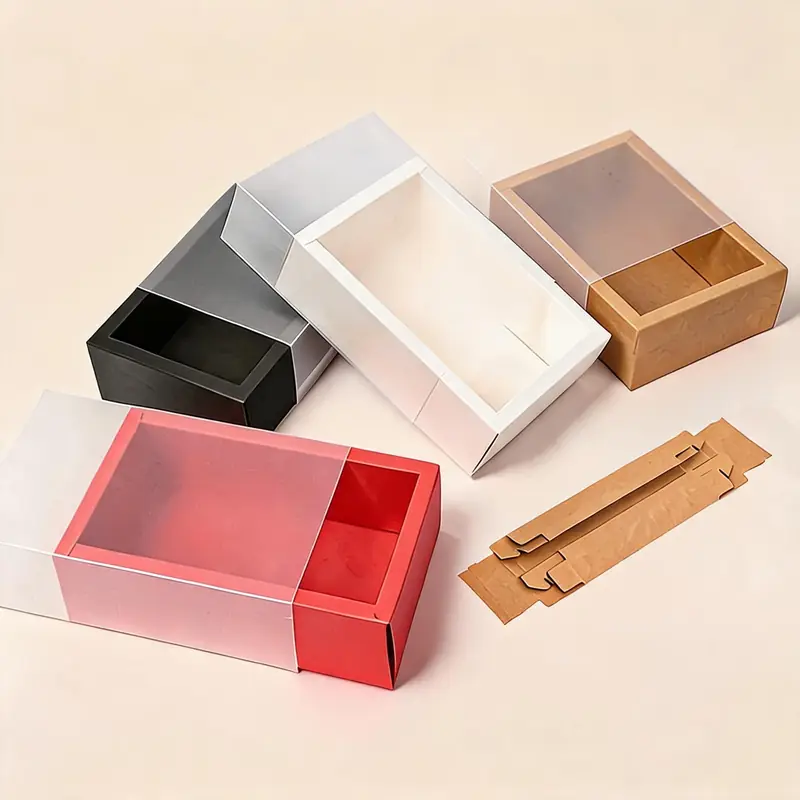 NewMade to order
Kraft Drawer Gift Box — Sliding Sleeve Box with Clear or Frosted Window
MOQ 50$0.15-0.84
EXW price
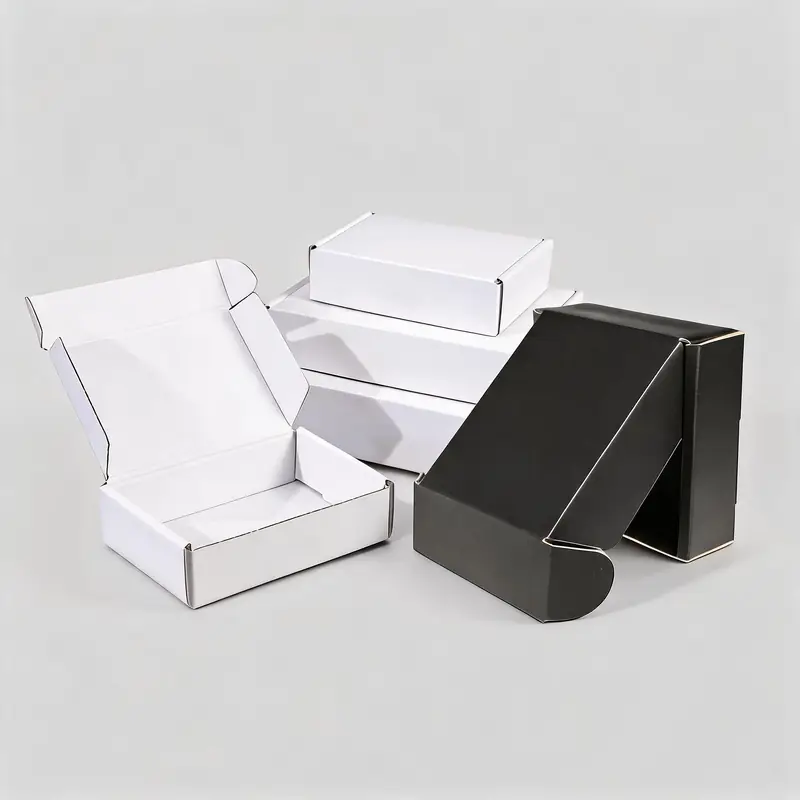 NewMade to order
Corrugated Mailer Box — Extra-Rigid E-Commerce Shipping Carton
MOQ 50$0.15-2.18
EXW price
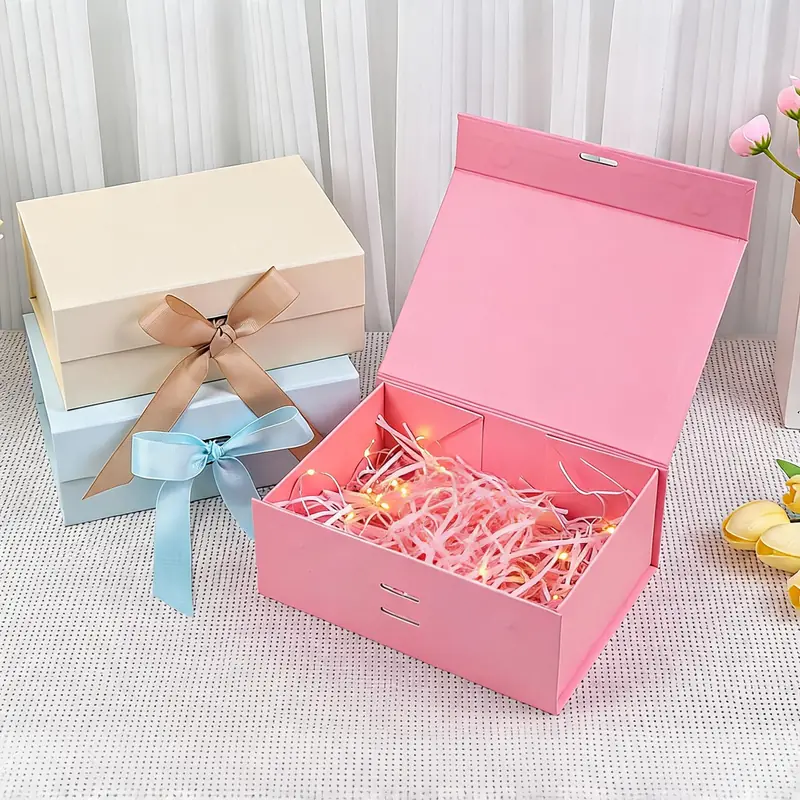 NewMade to order
Magnetic Foldable Gift Box — One-Piece Flip-Top Rigid Packaging Box
MOQ 100$1.56-3.66
EXW price
 Made to order
Thickened White Card Paper Gift Bag — Kraft & Laminated Shopping Tote
MOQ 100$0.08-0.56
EXW price
 Made to order
Organza Drawstring Gift Bag — Sheer Mesh Jewellery & Favour Pouch
MOQ 100$0.03-0.12
EXW price
Browse the full stock grids
Every current drawer box, magnetic box and mailer size is listed in the gift boxes category; the drawstring pouches category carries the full 7 × 9 to 20 × 30 cm organza grid. Compare your inner-size target against the variants before requesting a custom die.
Browse stock gift box and mailer sizesClearance rules: how much room to add
Packing a box to the millimetre is not a goal. Paper and board need clearance to assemble, and your product needs room for an insert and fingers to lift it out. The working rules below are what production samples are checked against; the white sample is where exact fit is finally signed off.
- Rigid boxes: aim for about 5 mm clearance on each horizontal axis once the insert is in. Zero clearance jams the tray; over 10 mm lets the product rattle and feel cheap.
- Mailers: the listed size is the outer footprint, so subtract flute and crease allowance before assuming fit. A product near the listed inner limit should be checked on a sample, not ordered direct.
- Inserts and padding: add their thickness to the product before sizing the box. A 5 mm foam bed adds 5 mm to height, and a wrapped or dust-bagged product adds 2–4 mm on the width.
- Pouches: use the flat size minus the ~2 cm cord channel, and choose the next tier up for rigid items near the limit.
- Bottle and candle orders: always measure across the cap or lid, which is wider than the body more often than buyers expect.
Five measuring mistakes that ruin packaging orders
- Swapping inner and outer. Ordering a box from an outer-size listing as if it were inner space is the classic mismatch; rigid boxes quote inner, mailers quote outer.
- Mixing centimetres and inches. A '9 × 6 × 4' written without a unit has been read wrong on every continent. Put cm or in after every set.
- Reordering the numbers. Width first, length second turns a long drawer into a square tray. Always longest first: L × W × H.
- Measuring the product at its slimmest. Caps, seams, folded hems and gift wrap add bulk. Measure the bulkiest configuration you will actually ship.
- Ignoring the flat-packed volume. A beautifully sized erected box that throws away half the container costs you margin on every reorder. Ask for the flat carton dimensions too.
When no stock size fits
A custom size means a new dieline, a new cutting die and a white sample before bulk production — the full process, artwork rules and MOQ logic are covered in our dieline guide for non-designers.
Read: Packaging Dieline Basics for Non-DesignersHow to send dimensions in an RFQ
The clearest enquiries our sales team receives all use the same one-line format, and they are quoted fastest because nothing has to be guessed: product is X × Y × Z mm at its bulkiest, insert adds N mm, required inner size is A × B × C mm, quantity Q, format preference (drawer / mailer / pouch). Add whether the figures are mm, cm or inches, whether a stock size may be substituted, and your destination country so freight can be estimated on flat-packed volume.
Send measurements, get a size recommendation back
Share your product dimensions, quantity and preferred format. We will match the closest stock size or quote a custom dieline, confirm inner vs flat figures, MOQ and lead time, and reply within one business day — a white sample follows in about 5–7 days if you want to test the fit.
Send your dimensions for a quoteBox and bag dimension FAQ
Frequently asked questions
How do you find the dimensions of a box?
Place the box on a flat surface with the opening facing up and measure inside: the longest opening edge is length, the shorter edge is width, and floor-to-lip is height. Record them in that order as L × W × H, in millimetres if possible, and label the figures inner or outer. If you are sizing for a product you do not yet have a box for, measure the product at its bulkiest point and add insert and clearance thickness.
What order do length, width and height go in?
Length × width × height, longest first — never reorder them to match how you happen to hold the box. Length is the longest edge of the opening face, width the shorter edge of that face, and height the rise from it. On soft bags the convention becomes width × height × gusset instead.
Are box dimensions inner or outer measurements?
It depends on the packaging type. Rigid gift boxes such as drawer and lid-off styles are quoted by inner dimensions, because that is the space for your product. Corrugated mailers are usually quoted by outer footprint, because shipping rates use the outer size. Always ask the supplier to state which one a listing shows, and add roughly 4–8 mm per axis for board walls when comparing the two.
How much clearance should I leave inside a gift box?
About 5 mm of clearance on each horizontal axis after the insert is in is the working target. Less than that and the tray can jam in production; more than about 10 mm and the product shifts and rattles. Exact fit is always confirmed on the white sample made from the production board before any bulk run starts.
How are mailer box dimensions measured?
Mailer box dimensions are normally the outer footprint — length × width × height of the erected corrugated box — because couriers price from outer size. Usable inner space is slightly smaller due to the corrugated flutes and folded creases. Our stock mailers span an outer grid from 15 × 15 × 5 to 45 × 35 × 10 cm; if your product sits close to an inner limit, order a sample first rather than assuming fit.
How are paper bag sizes measured, and what is a gusset?
Paper bags are measured flat as width × height × gusset. The gusset is the pleat folded into the sides and bottom that expands into the bag's depth when filled. Our white-card carrier bags run from 12 × 16 × 5.7 to 22 × 18 × 10 cm; a bag without a gusset stays a flat envelope regardless of its width, so boxed gifts always need a gusseted style.
How do you measure a drawstring pouch?
Pouches are quoted by flat width × height, but the cord channel across the top consumes about 2 cm of fill length, and cinching narrows the opening. A 15 × 20 cm pouch gives roughly 15 × 18 cm of usable space. Size rigid items against the usable rectangle and move up one size tier when the item is borderline; our organza range runs from 7 × 9 to 20 × 30 cm flat.
How do you convert L × W × H to CBM?
Convert centimetres to metres and multiply: CBM = L × W × H in metres. In centimetres, multiply the three numbers and divide by 1,000,000. A 60 × 40 × 40 cm carton is 0.096 CBM; for a shipment, multiply one carton's CBM by the number of cartons. Mixing cm and m between dimensions is the usual arithmetic error and shifts the result by a factor of 100.
What is volumetric weight and how do I calculate it?
Volumetric weight converts shipment volume into a notional kilogram figure for air freight: L × W × H in cm ÷ 6,000. The carrier bills the greater of volumetric weight and actual gross weight, so large light cartons are charged by volume. Flat-packed and nested packaging lowers volumetric weight, which is part of why folding boxes and flat mailers freight cheaper than erected rigid formats.
What if none of the stock sizes fits my product?
A size outside the stock grid needs a new dieline and cutting die, which typically starts around MOQ 500 and begins with a 5–7 day white sample so fit is proven before tooling is committed. Send the product dimensions in the RFQ format above; often the closest stock drawer or mailer size plus a designed insert fits well enough to start at MOQ 50, and the custom structure can follow once the product is proven.
Need these boxes, bags or ribbon?
Send your product dimensions or dieline and get a quote with MOQ and sample lead time within one business day.