Packaging Dieline Basics for Non-Designers: From Template to Finished Box
A packaging dieline guide for buyers, not designers: how dielines, cutting dies and samples work, how to read inner and flat dimensions, artwork bleed and safe zones, and the real stock size grids, MOQ and lead times for rigid boxes, mailers and paper bags.
If you have ever ordered custom packaging, a factory has probably asked you for a dieline, or sent you a strange-looking file full of rectangles and dashed lines. A packaging dieline is simply the flat, unfolded blueprint of your box or bag: the exact shape before it is cut, scored and glued into 3D. You do not need to be a designer to work with one, but understanding how dielines, cutting dies and samples relate will save you from the three expensive mistakes buyers make: wrong dimensions, artwork placed on a fold, and paying for a custom die when a stock format already fits. This guide walks through the whole process and ends with the real size grids, MOQ and lead times behind the boxes, mailers and bags in our catalogue, so you can check whether your product fits an existing dieline before anyone charges tooling.
What is a packaging dieline?
A dieline is a vector drawing, almost always an Adobe Illustrator file, that marks every edge of the finished flat blank: where the blade cuts, where the board is scored for folding, where glue tabs join, and where bleed and safe margins sit. The same file serves two masters. The factory's tooling team uses the cut and score paths to make the physical cutting die, and the print team uses the artwork layer to position your logo and graphics. Both teams must work from one identical file, which is why suppliers insist on clean, layered artwork rather than a logo pasted into a screenshot.
Three terms are often mixed up. The dieline is the digital template. The die-cut (or cutting die) is the physical wooden form fitted with steel blades and creasing rules, produced from that template, that punches the flat shape out of the board on a press. Die-cutting is the process itself. A standard format needs none of this to be made new — the die already sits on the factory's shelf, which is the single biggest reason stock packaging starts at MOQ 50 while a custom structure starts around 500.
Want the 4-minute version first?
Our quick answer covers what a dieline is and the line conventions in one short read. This long guide adds the full process, artwork rules and real size grids.
Read: What Is a Dieline? (quick answer)The anatomy of a dieline: lines, zones and tabs
Dielines are read by line style, not colour, and a correctly built file keeps each element on its own labelled layer. When the factory opens your artwork, they will hide the artwork layer and check the structural paths first.
| Element | What it marks | Artwork rule |
|---|---|---|
| Cut line | Solid outline where the blade cuts through the board | Final flat shape of the box; nothing important may touch it |
| Crease / score line | Dashed or dotted line where the board folds | No ink band across a fold; dark ink on a crease can crack |
| Bleed | Artwork extending beyond the cut edge | 3 mm on every side; prevents white edges if the cut shifts |
| Safe zone | Inner margin from cuts, scores and folds | Keep logos and text 3–5 mm inside it |
| Glue tab | Flap bonded during assembly | Leave completely clear of graphics and barcodes |
| Perforation | Partial-cut tear line | Used for tear strips and hang tabs; mark on its own layer |
| Foil / spot UV layer | Separate 100% solid shape for each special finish | One named layer per process; never a shadow or gradient |
Conventions vary slightly by supplier; always finalise artwork against their template, not a generic one downloaded online.
From dieline to cutting die to a box in your hand
The process is the same for every factory, and knowing the sequence makes quotes and lead times much easier to read.
- Structure and dimensions are confirmed. For a stock format the supplier sends an existing dieline template at no cost; for a custom size the technical team draws a new one from your product dimensions.
- You drop artwork into the template — logo, colours, any special-finish layers — and return the file. Fonts outlined, links embedded, colours specified by Pantone or CMYK.
- For a custom structure only, a cutting die is produced: a wooden board fitted with steel cutting blades and creasing rules to match the dieline paths. This one-time tooling is the reason custom boxes carry a die fee and a higher MOQ.
- A white sample is made: an unprinted blank cut and folded from the intended board, so you can test the fit with your real product. Sampling takes about 5–7 days.
- After fit approval, a printed proof or pre-production sample confirms colour and finish, then the bulk run is die-cut, scored, printed, glued and QC-packed flat.
The sample step is not optional in practice. Board has thickness, and a nominal 16 × 10 × 5.5 cm drawer does not give you 16 × 10 × 5.5 cm of usable space — the inner tray is sized to the product while the outer sleeve adds wall thickness. A white sample on the real item is what catches a tight fit before 5,000 boxes are made.
The formats that already have dielines: real size grids
These are the actual stock size grids currently in production, pulled from our catalogue variants. If your product fits one of these inner dimensions, the dieline and die already exist: you pay no tooling, MOQ starts at 50–100 pieces, and logo-only orders dispatch in 7–10 days after artwork approval. Only a size or structure outside these grids needs a new dieline and the ~500-piece custom threshold.
| Format | Stock size grid (cm unless noted) | Stock MOQ | Logo order lead time |
|---|---|---|---|
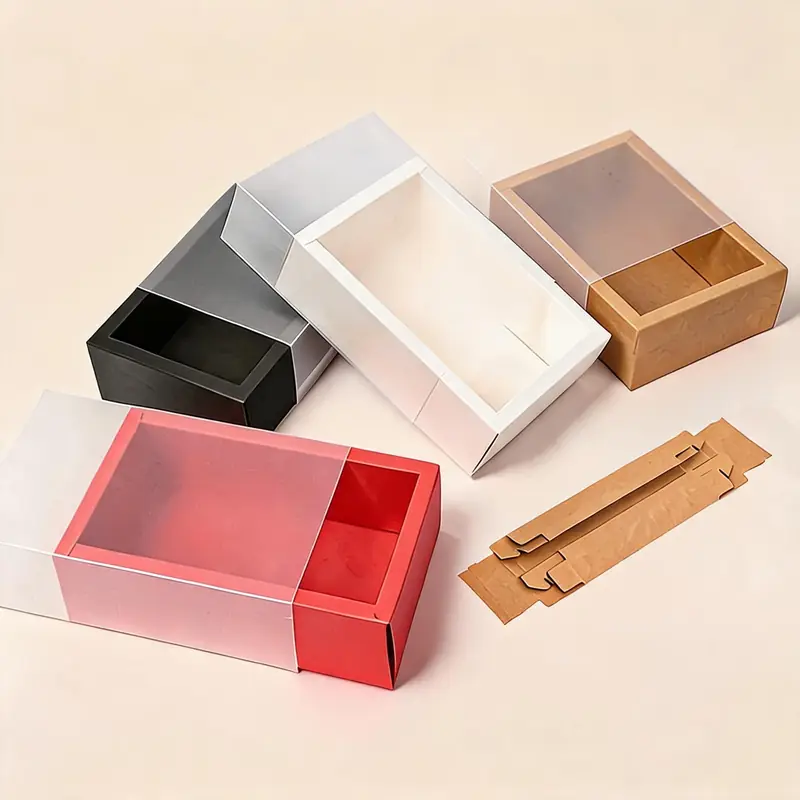
| Kraft drawer gift box (PVC sleeve) | 8 × 5 × 3 · 16 × 10 × 5.5 · 24.5 × 14 × 8.5 inner trays | 50 pcs | Dispatch ~7 days |
| Folding kraft drawer box | 6.5 × 6.5 × 3 · 15 × 8 × 4 · 18 × 10 × 6 · 23 × 15 × 5 · 25.5 × 15 × 9 · 30 × 17.5 × 9 | 50 pcs | Dispatch ~7 days |
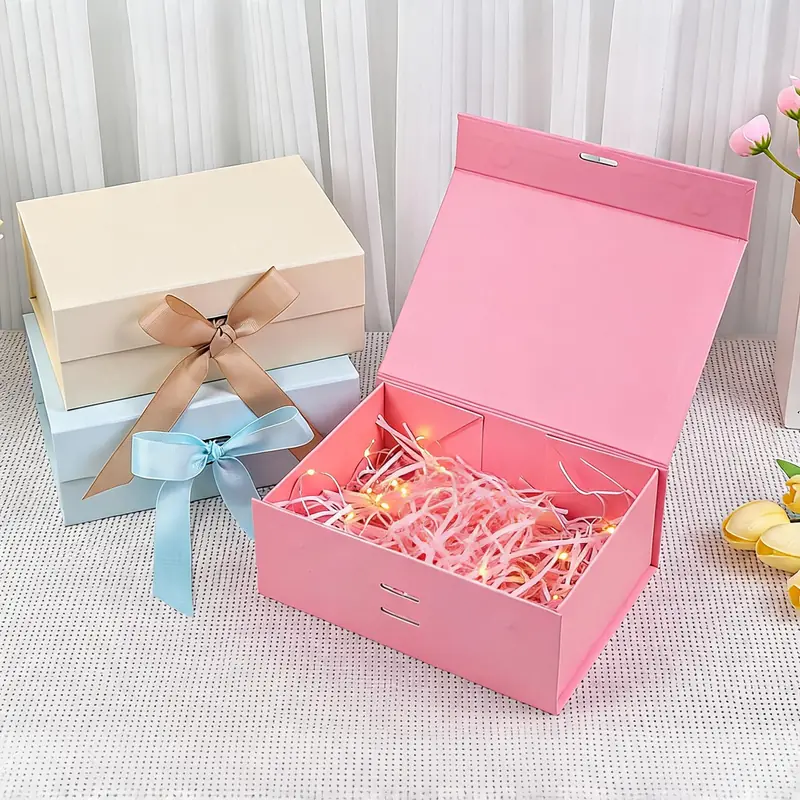
| Magnetic folding gift box | 22 × 16.6 × 8.6 (S) · 24 × 18.6 × 10.6 (M); ships flat at ~30 × 22 × 2, ~200 g each | 100 pcs | ~10 days after artwork approval |
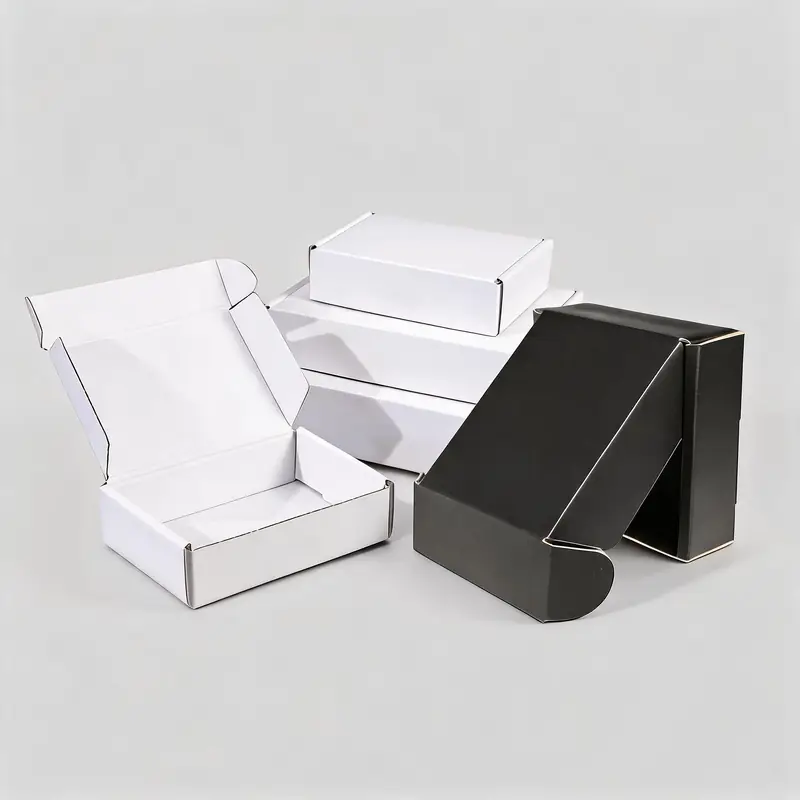
| Extra-rigid corrugated mailer box | 15 × 15 × 5 · 16 × 16 × 7 · 18 × 11 × 5 · 20 × 14 × 4 · 25 × 20 × 7 · 30 × 26 × 6 · 31 × 22 × 4 · 36 × 26 × 6 · 38 × 26 × 6 · 40 × 30 × 4 · 45 × 35 × 8 · 45 × 35 × 10 | 50 pcs | Dispatch ~7 days |
| Small card mailer / retail box (350 g card) | 65 × 65 × 30 · 70 × 70 × 30 · 75 × 75 × 30 · 90 × 90 × 40 · 125 × 125 × 40 mm | 50 pcs | Dispatch ~7 days |
| 260 g kraft / card paper bag | 12 × 16 × 5.7 · 15 × 20 × 6 · 16 × 22 × 8 · 20 × 28 × 10 (portrait) · 22 × 18 × 10 (landscape) | 100 pcs | ~10 days after artwork approval |
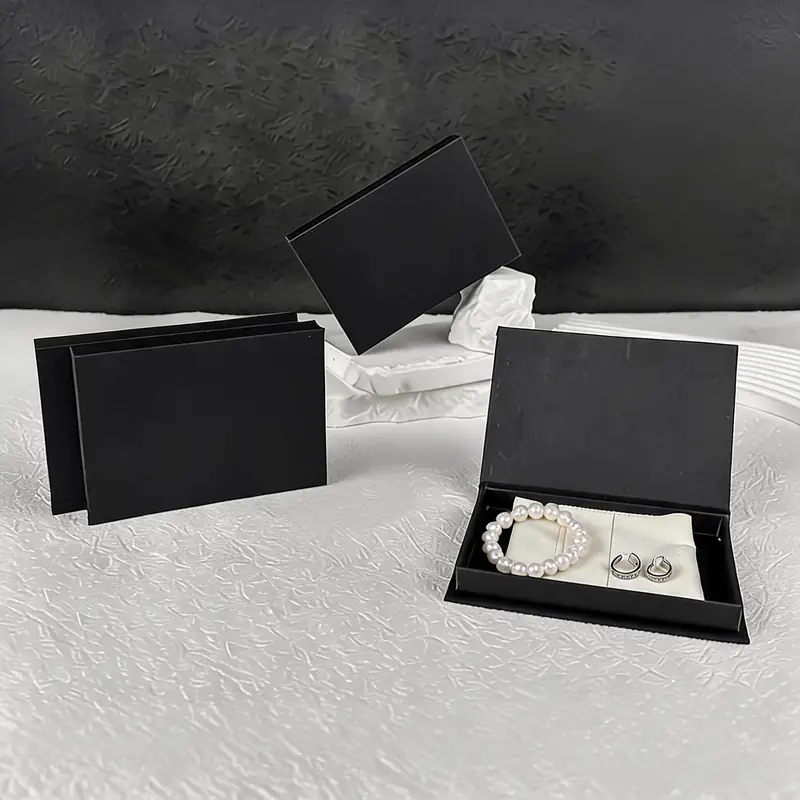
| Book-style magnetic jewellery box | 9.5 × 9.5 × 3.8 · 10 × 10 × 4.5 · 11.5 × 11.5 × 3.8 · 13 × 8.5 × 4 · 16 × 12 × 5 | 50 pcs | Dispatch ~7 days |
| Fully custom lid-off jewellery box (made to order) | Example 84 × 57 × 28 mm; your dieline and dimensions | 500 pcs | New cutting die; sample ~5–7 days, then bulk |
Inner/usable dimensions per variant listing; measured by hand on production samples. Exact fit is always confirmed on the white sample.
How to use this table
Measure your product, add its insert or padding, and compare against the inner grid. Anything within about 5 mm of a stock inner size can usually be made to fit with insert design — no new die, MOQ 50–100. Browse the gift boxes and mailer categories to see the exact variants.
Browse stock gift box formatsReading dimensions: inner size, outer size, flat size
Three different measurements circulate on a packaging order, and most sizing disputes come from assuming they are the same number.
- Inner size is what fits your product. Rigid box variants are quoted by inner tray dimensions — the 16 × 10 × 5.5 cm drawer above describes usable space, not the outside of the sleeve.
- Outer size is the assembled box footprint plus board walls, used for master carton packing and freight planning. It is always larger than the inner size on rigid construction; mailers quote the outer footprint because that is what shipping rates use.
- Flat (folded) size is what actually travels. Magnetic folding boxes and mailers ship as flat blanks: the magnetic box above occupies roughly 30 × 22 × 2 cm per unit stacked flat, which is dramatically cheaper to freight than the erected 24 × 18.6 × 10.6 cm form.
When you send dimensions, state the order as length × width × height in centimetres or millimetres, and label whether each is product size, desired inner size or finished outer size. The single most useful line you can write on an RFQ is: product is X, insert adds Y, so required inner size is Z.
Placing artwork without the five classic mistakes
Factories reject or silently fix artwork every week. The issues are almost never creative — they are mechanical.
- Missing bleed: background colour ends exactly on the cut line. A 1–2 mm cutting shift leaves a white sliver. Extend backgrounds 3 mm past every cut.
- Type too close to a fold or edge: text inside the 3–5 mm safe zone clips or bends over a crease, and ink sitting on a score line can crack when folded.
- Graphics on the glue tab: anything printed on the bonding flap is invisible and can interfere with adhesion; keep the tab blank.
- Fonts not outlined or images under 300 dpi: the factory will not have your font file, so text reflows. Outline all type and send vector logos (.ai, .eps, .svg) rather than screenshots.
- Foil and spot UV painted as effects: each special finish needs its own layer with a solid 100% shape showing exactly where the die applies. A glossy Photoshop effect cannot be tooled.
Colour discipline matters more than buyers expect: specify print colours as CMYK or, better, Pantone numbers for brand-critical logos. RGB files look identical on screen but print duller or shifted because packaging presses run four-colour process plus spot inks. If a finish is involved — hot foil stamping or spot UV on our magnetic boxes, for example — name the finish layer separately so the quote includes the extra press pass and its MOQ implication.
Stock dieline vs custom dieline: MOQ, fees and timing
| Stock format + your logo | Fully custom dieline | |
|---|---|---|
| Cutting die | Already exists | New die, one-time fee quoted up front |
| Typical MOQ | 50–100 pcs | Around 500 pcs |
| Sampling | Often photo/sample of same structure; white sample 5–7 days | New-structure white sample 5–7 days before any tooling commitment |
| Lead time | ~7–10 days after artwork approval | Sample approval, then the standard production window |
| Best for | First order, testing a product, small brands | Proven product where the exact fit or structure is the brand |
The economic logic is simple. A cutting die, ink mixing and press setup cost roughly the same whether the run is 100 or 10,000 pieces, so a custom structure cannot be priced at MOQ 50. The made-to-order lid-off jewellery box in our own range illustrates the threshold honestly: custom dieline, 84 × 57 × 28 mm, MOQ 500. A smart first order usually starts on the closest stock format — same logo, same foil, 50 pieces — and moves to a custom dieline once the product and sell-through are proven.
No dieline? Here is exactly what to send
You never need to draw a dieline yourself to start an order. Send the product itself, or a short spec: product dimensions in cm or mm, whether it needs an insert (foam, velvet, blister, crinkle paper), the box style you like (drawer, magnetic folding, lid-off, mailer), expected order quantity, and a photo of any packaging you want to match. From that, a supplier either maps you to an existing dieline from the grids above or draws a custom one and schedules a white sample. Approvals happen on the physical sample, not on screen, so dimension risk stays with the factory before bulk production.
Stock formats whose dielines and cutting dies already exist — MOQ 50–100, logo orders in 7–10 days. Custom sizes quote around MOQ 500 with a white sample first.
 NewMade to order
Kraft Drawer Gift Box — Sliding Sleeve Box with Clear or Frosted Window
MOQ 50$0.15-0.84
EXW price
 NewMade to order
Magnetic Foldable Gift Box — One-Piece Flip-Top Rigid Packaging Box
MOQ 100$1.56-3.66
EXW price
 NewMade to order
Corrugated Mailer Box — Extra-Rigid E-Commerce Shipping Carton
MOQ 50$0.15-2.18
EXW price
 Made to order
Thickened White Card Paper Gift Bag — Kraft & Laminated Shopping Tote
MOQ 100$0.08-0.56
EXW price
 NewMade to order
Slim Book-Style Jewelry Box — Textured Paper Case
MOQ 50$0.93-1.44
EXW price
Send dimensions, get a dieline back
Share your product dimensions, preferred box style and quantity. We will confirm the matching stock dieline or quote a custom one, with MOQ, lead time and a white sample in about 5–7 days — reply within one business day.
Request a dieline check and quotePackaging dieline FAQ
Frequently asked questions
What file format do I need for a packaging dieline?
A vector Adobe Illustrator file (.ai) with outlined fonts and separate, clearly named layers for cut lines, crease lines, artwork and any foil or spot UV. Vector paths scale without losing accuracy; a flat JPG or PNG cannot reliably drive a cutting die. If you only have a PNG or JPG logo, send it anyway — the factory's artwork team can rebuild it as vector for the template.
How much bleed should packaging artwork have?
3 mm of bleed on every cut edge is the packaging standard, with a 3–5 mm safe zone inside the cuts and folds for logos and text. Backgrounds and photos extend into the bleed; nothing important sits inside the safe margin. The exact margins are always confirmed on the supplier's own template, which is built to their die tolerances.
Do I have to pay for a cutting die for every custom box order?
Not every order, and not for stock formats. The cutting die is a one-time tooling item produced only for a new custom dieline. Stock sizes reuse existing dies, so logo-only orders carry no tooling fee and start at MOQ 50–100. On repeat custom orders the same die is reused, so the fee is not charged again as long as the dimensions do not change.
Why is the MOQ 500 for a custom size but 50 for a stock box?
Because a custom size needs a new cutting die, press setup and print proofs — fixed costs that are spread across the run. A stock format already has its dieline, die and running production line, so the only setup is branding. The 500-piece threshold is the point at which the custom run becomes economical; our made-to-order boxes are quoted at exactly that level.
How long does a dieline sample take?
A white sample — an unprinted blank cut and folded on the intended board — takes about 5–7 days. Logo orders on stock formats dispatch roughly 7 days after artwork approval for drawer boxes and mailers, or about 10 days for magnetic folding boxes and paper bags with hot-stamping or UV work.
What is the difference between inner and outer box dimensions?
Inner dimensions describe the usable space for your product and insert; rigid boxes are quoted this way. Outer dimensions include the board walls and are used for carton packing and freight. Mailers are typically quoted by outer footprint because that drives shipping rates. Always label which one you mean when sending measurements.
Can the same dieline be reused for different products?
Only when the products share dimensions and insert thickness. The same structure can be reprinted with new artwork at low MOQ any number of times, and the die stays valid. A change in size, depth or closure moves folds and cut paths, which means a new dieline, a new cutting die and the custom-order MOQ.
What happens to my logo on folds and glue tabs?
Ink on a crease can crack when the board is folded, and anything printed on a glue tab is neither visible nor always bond-safe. Keep all meaningful artwork in the safe zone on panels that stay flat and visible when erected. If a design truly needs colour across a fold, the factory will plan it as a controlled wrap-around rather than a logo sitting on the score.
Should colours be RGB, CMYK or Pantone?
Send CMYK for full-colour photographic artwork and Pantone (spot colour) numbers for brand-critical logos or exact colour matches. Do not rely on RGB: screens render RGB, but packaging presses run CMYK plus spot inks, so an RGB file converts unpredictably. Each foil or spot-UV area should be a separate solid layer, not an effect in Photoshop.
Can I check the fit before committing to a bulk order?
Yes, and you should. After the dieline is confirmed, a white sample is made from the production board for you to test with the real product and insert; only after fit approval does bulk production start. On stock formats the structure is proven, so many buyers approve from a sample of the same format and proceed directly to the logo run.
Need these boxes, bags or ribbon?
Send your product dimensions or dieline and get a quote with MOQ and sample lead time within one business day.