Magnetic Closure Gift Boxes Wholesale: Folding Rigid Boxes with Magnetic Lid
Magnetic closure gift boxes wholesale: foldable rigid boxes with hidden magnet lids. Sizes, finishes, freight savings, MOQ and lead time.
Magnetic closure gift boxes are the format buyers ask about most when sourcing premium gift packaging, and it is easy to see why. A rigid-feeling box with a lid that snaps shut on hidden magnets gives the weighty, engineered unboxing of a luxury set-up box, while the one-piece folding version ships and stores almost flat — solving the two complaints that come up again and again with rigid packaging: freight cost and warehouse space. This guide explains how a magnetic closure box is built, compares it with lid-and-base rigid boxes and plain folding cartons, and gives the actual stock size grid, colours, logo methods, MOQ and lead time behind our magnetic line, so you can specify one with confidence.
What is a magnetic closure gift box?
A magnetic closure gift box is a rigid-style box whose lid is held shut by small magnets sealed inside the board, rather than by friction, tucks or ribbon. The magnets are completely hidden — there is no visible clasp or hardware — so the lid closes with a quiet, definite click and reopens by lifting the front lip. On the folding type that dominates wholesale orders, the whole box is engineered as a single die-cut blank of greyboard wrapped in specialty paper: hinged at the spine with tape, creased at the corners, and reinforced with internal folds that turn the flat sheet into walls when you assemble it. The result is a box that feels and opens like a permanent set-up box but arrives as a thin, stackable panel.
There are two magnetic formats on the market. The foldable one-piece box described above is the freight-efficient choice for export orders and is what this guide focuses on. The second is a conventional rigid set-up box — a base with a separate or book-style hinged lid — that simply uses magnets instead of a friction fit; it is supremely premium but ships fully assembled. If you have only seen magnetic boxes in retail, you have probably handled both without realising it, because from the outside they look nearly identical.
Magnetic folding box vs rigid set-up box vs folding carton
| Foldable magnetic box | Rigid set-up (lid-and-base) box | Folding carton | |
|---|---|---|---|
| Board | 1.5–2 mm rigid greyboard, paper-wrapped | 1.5–2.5 mm rigid greyboard, paper-wrapped | Thin printed paperboard, ~300–400 gsm |
| Closure | Hidden magnets, flip-top | Friction-fit lid (or magnets on upgraded lines) | Tuck flaps, no hardware |
| How it ships | Flat, one piece; folds into shape | Fully assembled, full of air | Flat; glued and folded by hand |
| Feel | Weighty, rigid, mid-premium to premium | The most weighty and premium | Light and practical |
| Typical MOQ (stock structure) | From 100 pcs | Stock formats from 50–100; custom ~500 | Usually high; printing-driven |
| Best for | Branded gifts, cosmetics, hampers, export | Jewelry, watches, luxury goods | E-commerce, retail, light products |
Where the three mainstream gift box formats sit. The foldable magnetic box is deliberately a hybrid of the two older formats.
Deeper comparison
Freight, assembly labour and perceived value across rigid and folding formats are compared line by line in our rigid vs folding gift boxes guide.
Read: Rigid vs Folding Gift BoxesThe practical upshot: a foldable magnetic box is the sweet spot when you want the unboxing of a rigid box but the boxes travel a long way, your storage space is limited, or your quantities sit in the hundreds rather than thousands. It is not quite as dense in the hand as a thick set-up box, and it needs a minute of folding per unit on your fulfilment line, but most buyers find both trade-offs small next to the freight saving.
How the folding construction works
The one-piece construction is what makes the format possible. The blank is a flat cross of greyboard wrapped in laminated specialty paper, scored precisely where the walls will rise. Two rails pre-attached to the inside of the lid and front panel house the magnets and their matching metal plates; reinforced corner folds lock the base square without glue on your side. To assemble, you press the sides up, tuck the corner folds, and press the lid closed — the magnets index the shut position for you. Because the magnets and hinges are built in at the factory, assembling 100 boxes is a matter of minutes, and the box can be flattened again for storage without damage.
That construction also sets the limits of the format. The hinge and fold lines need a wrap paper flexible enough to take a sharp crease, which is why stock lines use coated or specialty paper around 157 gsm over matte lamination rather than very rigid laminated boards. A correctly built magnetic box will hold its square through hundreds of open-and-close cycles; a cheaply built one reveals itself early, when the corner folds soften and the lid starts to sag. Asking where the magnets are fitted and how the corners are reinforced tells you a lot about a supplier's quality floor.
Stock size grid and what fits inside
Our stock foldable magnetic line runs in five erected sizes across one construction. Dimensions are the finished box dimensions in centimetres; always match them against the outer size of your product plus insert clearance, not the product alone.
| Code | Erected size (L × W × H) | Typical contents |
|---|---|---|
| S | 22 × 16.6 × 8.6 cm | Single cosmetics bottle, small jewelry set, chocolates, candle |
| M | 24 × 18.6 × 10.6 cm | Skincare set, medium candle, mug, small gift set |
| M-Flat | 26 × 19 × 8.6 cm | Scarf, book, apparel accessory, folded textiles |
| L | 29 × 22 × 10.6 cm | Apparel gift box, hamper base, larger candle or skincare bundle |
| XL | 33 × 25 × 12.6 cm | Corporate gift sets, large hampers, multi-product bundles |
Stock foldable magnetic gift box grid (item 251216-MAGNETIC-FOLD). All sizes share the same one-piece construction, matte-laminated wrap and hidden flip-top magnets.
For reference, the M size — 24 × 18.6 × 10.6 cm erected — folds to a flat blank roughly 30 × 22 × 2 cm, which is the number that matters for carton packing and freight. The larger codes fold proportionally longer. If your product lands between two codes, size up and close the difference with an insert rather than squeezing: a box packed to the millimetre resists closing and crushes its corners.
Matching product to box size
Measure your product at its bulkiest point, add the insert thickness on all sides, and compare against the erected grid. Inner vs outer dimensions, flat-packed sizes and clearance rules are covered in our box and bag measuring guide.
Read: How to Measure Box and Bag DimensionsFreight and storage: why the box folds flat
Freight is where foldable magnetic boxes earn their place in an export order. The flat blank removes almost all the empty air inside an assembled rigid box — our line is rated to cut shipping volume by up to 80% versus an equivalent erected set-up box. On a sea-freight order that changes how many units fit a carton and a container directly; on air freight, where chargeable weight follows volume, the difference is larger still. Flat panels also stack without crush risk and occupy a fraction of the shelf space in a 3PL warehouse, so brands that pre-order packaging for a seasonal push do not need to store pallets of hollow boxes for months.
The honest trade-offs are two: a minute or two of folding labour per unit on your side, and a box that — once assembled — is best kept assembled if it is being shipped onward to a retailer, because repeatedly flexing the creases adds wear. If your boxes go straight to end customers via your own fulfilment line, folding on demand is ideal; if they ship domestically pre-assembled, compare the flat volume saving against your packing labour before deciding.
Turning the numbers into freight cost
CBM for sea freight and volumetric weight for air freight both come straight from carton dimensions. The flat-blank size, not the erected size, is what you use when comparing suppliers on freight — the formulas are in our CBM guide.
Read: How to Calculate CBM for ShippingColours, finishes and logo methods
The stock line is wrapped in matte-laminated specialty paper — a fingerprint-resistant, scratch-resistant finish that photographs cleanly and makes foil read sharply — in five colours: white, premium black, blush pink, sky blue and elegant beige. White and black cover corporate and luxury briefs; blush and sky are the event, wedding and baby-shower favourites; beige is the neutral for natural, spa and food-hamper brands. Optional raffia-grass filler can be ordered with the box for hamper presentation.
Four logo methods are available on stock structures: hot-foil stamping (gold, silver and matte foils — the most popular choice on the lid), UV printing for spot-gloss or full-colour marks, embossing and debossing (an inkless pressed mark, including blind debossing), and full-colour print for photographic artwork. On a matte-laminated lid, foil and blind deboss are the combinations that read most premium; full-colour print is reserved for brands whose artwork genuinely needs it. Artwork should be vector, with bold shapes for foil and deboss rather than fine hairlines.
Choosing between foil and deboss
Foil adds metallic contrast; debossing adds tactile depth with no colour at all; the two can be combined in one registered mark. The artwork rules, MOQ logic and proof process for each are compared in our debossing vs embossing guide.
Read: Debossing vs Embossing on Gift BoxesMOQ, samples, lead time and custom sizes
On our magnetic line, stock sizes with custom branding start at MOQ 100 pieces, because the cutting dies and fold tooling already exist — only the logo die or print plate is made new. A white sample and a printed or foiled proof on the actual wrap follow in about 5–7 days, and once artwork is approved, branded stock orders dispatch within about 10 days. Custom colours and fully bespoke sizes need a new dieline and die-cutting form, which is why custom-structure orders typically start around 500 pieces and carry a longer window; any tooling fee is confirmed in writing on the quote before you commit.
Planning a custom structure
A custom size starts with a dieline — the die-cut template showing panels, folds and magnet positions — followed by a white sample before any tooling is paid for. The full process is explained step by step in our dieline basics guide.
Read: Packaging Dieline Basics for Non-DesignersWhat goes inside: inserts, filler and matching packaging
The deep lid of a magnetic box (8.6–12.6 cm in the stock grid) leaves room to present rather than merely pack a product. Three interior setups cover most orders: raffia grass for hampers and food gifts; a foam, EVA, velvet-flocked or cardboard insert with cut-out cavities for jewelry, cosmetics or multi-piece sets; or simply folded tissue for apparel and soft goods. Because the box is rigid, the insert does the protective work while the box supplies the perceived value — the two are specified together. The same branding can be repeated on a matching ribbon or a paper carrier bag so the set stays coherent from outer box to unwrapping.
Compare the full gift box range
The gift boxes category lists every current drawer, magnetic, window and lid-and-base format with its stock sizes, so you can compare structures against this grid before requesting a quote.
Browse all gift boxesThe foldable magnetic box is the lead format. The book-style slim box is a smaller magnetic closure for jewelry; the window rigid box and kraft drawer are the alternatives when you want a pre-assembled set-up or a sliding closure instead.
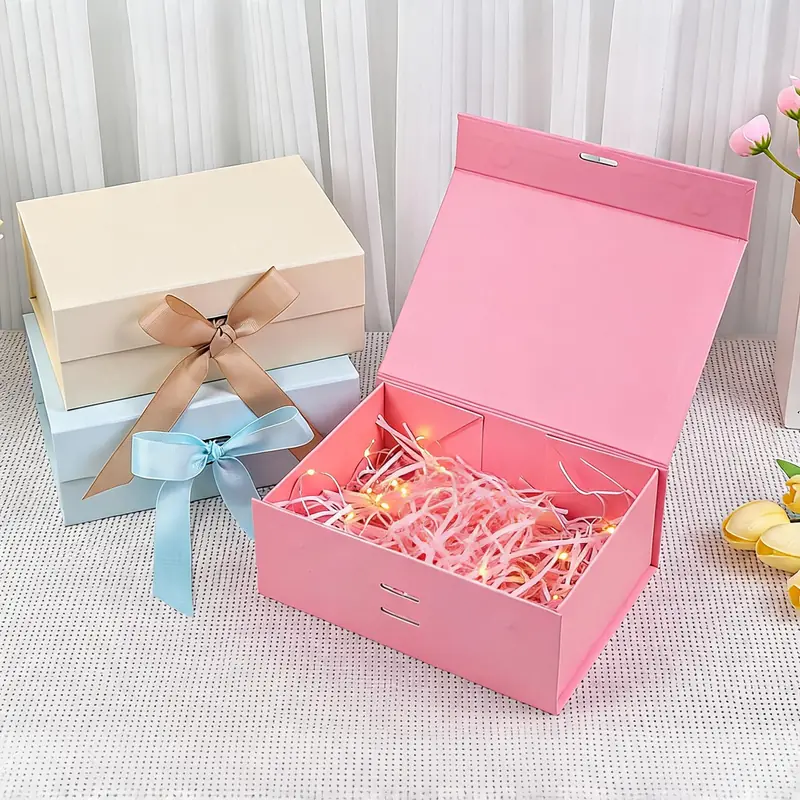 NewMade to order
Magnetic Foldable Gift Box — One-Piece Flip-Top Rigid Packaging Box
MOQ 100$1.56-3.66
EXW price
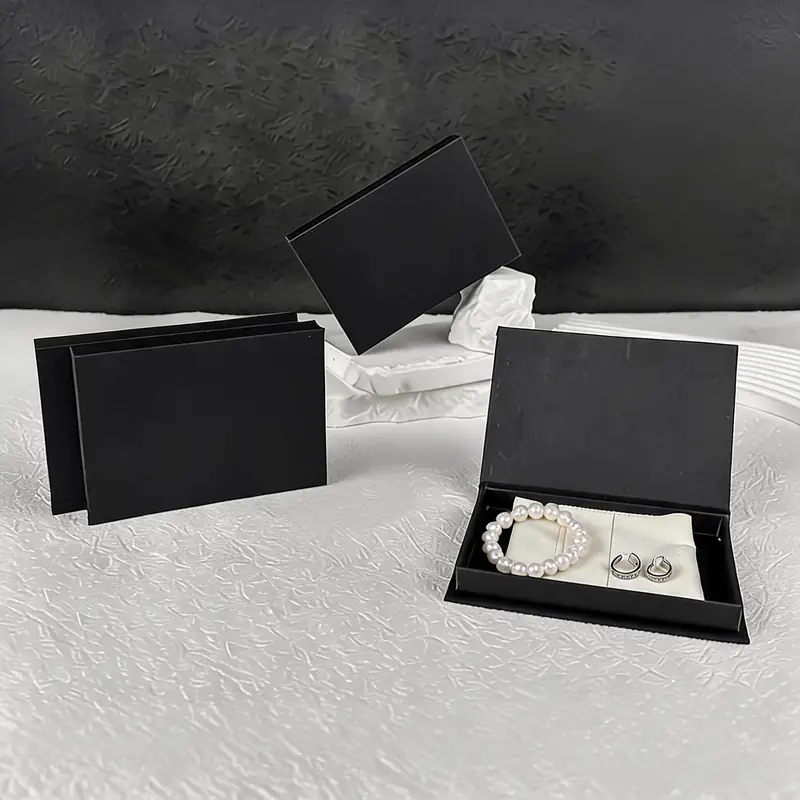 NewMade to order
Slim Book-Style Jewelry Box — Textured Paper Case
MOQ 50$0.93-1.44
EXW price
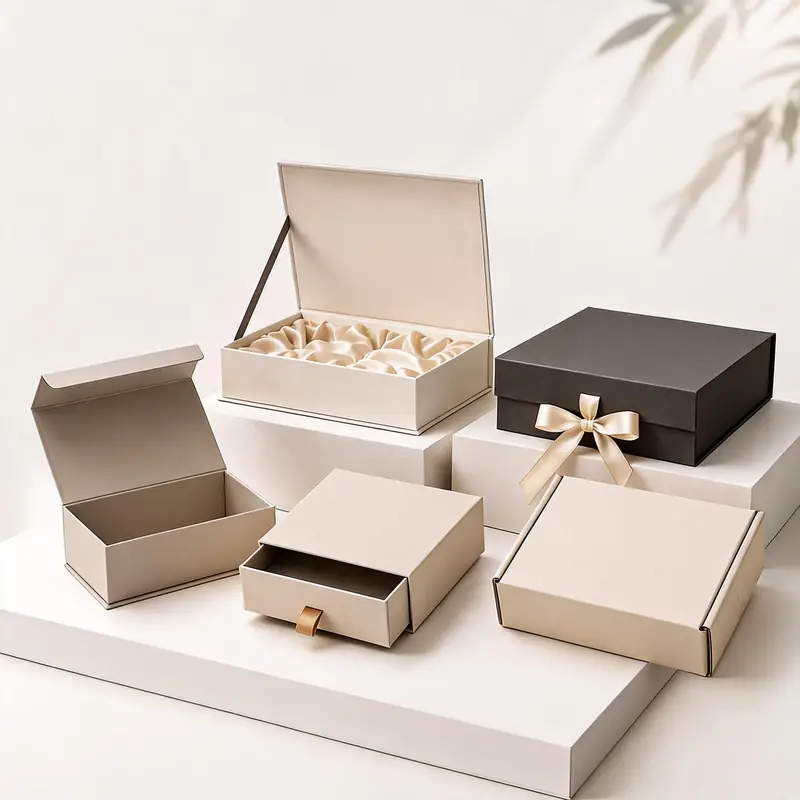 NewMade to order
Rigid Custom Gift Box — Lid & Base, Drawer, Book-Style & Window Formats
MOQ 50$0.15
EXW price
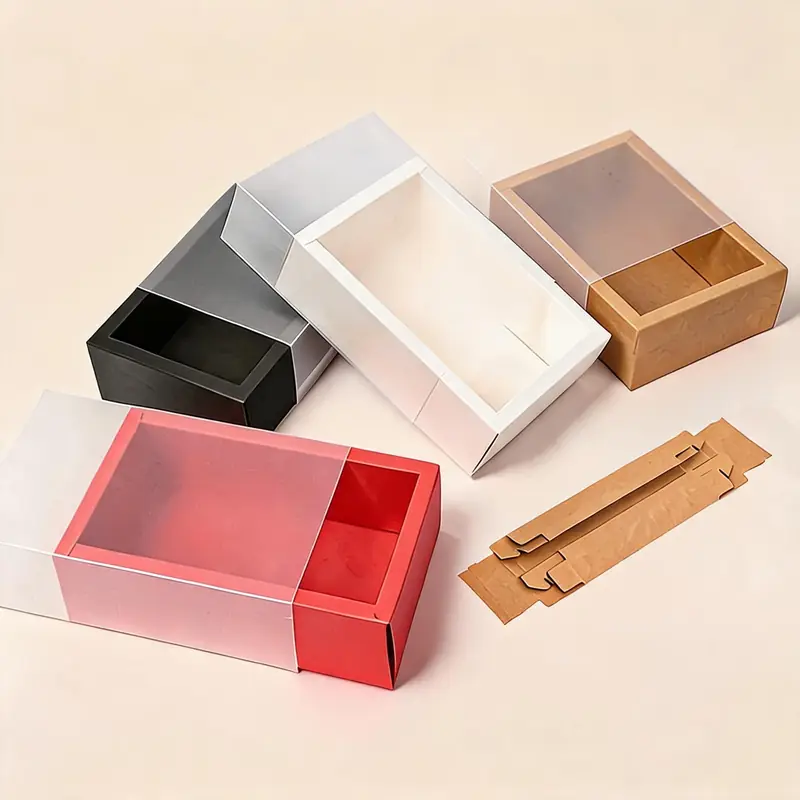 NewMade to order
Kraft Drawer Gift Box — Sliding Sleeve Box with Clear or Frosted Window
MOQ 50$0.15-0.84
EXW price
Specify a magnetic box in one RFQ
Send your product dimensions and weight, preferred stock size and colour, quantity and logo artwork. We will confirm fit, recommend finish and insert, and quote MOQ, tooling and lead time in writing — most requests get a detailed reply within one business day, with a white sample and proof in 5–7 days.
Request magnetic gift box pricingFrequently asked questions
What is a magnetic closure gift box?
It is a rigid-style gift box whose lid is held shut by small magnets hidden inside the board, with no visible clasp. The lid closes with a firm click and reopens from a front lip. The folding version is made as a single paper-wrapped greyboard blank that arrives flat and folds into a rigid-feeling box.
What is the difference between a magnetic box and a rigid set-up box?
Both use thick greyboard wrapped in paper and feel premium. A conventional set-up box is permanently assembled and ships that way, full of air; a foldable magnetic box ships flat as one piece and folds up on receipt. A foldable magnetic box is very close in feel but freights and stores far more efficiently, typically from MOQ 100.
Do magnetic gift boxes ship flat?
The foldable one-piece type does. The M size, 24 × 18.6 × 10.6 cm erected, folds to a blank around 30 × 22 × 2 cm, and the construction is rated to reduce shipping volume by up to 80% versus an assembled rigid box. Assembly needs no glue — you raise the creased sides and corner locks by hand, then close the magnetic lid.
What sizes do wholesale magnetic boxes come in?
Our stock line has five erected sizes: S 22 × 16.6 × 8.6 cm, M 24 × 18.6 × 10.6 cm, M-Flat 26 × 19 × 8.6 cm, L 29 × 22 × 10.6 cm and XL 33 × 25 × 12.6 cm, in white, black, blush pink, sky blue and beige. Custom sizes are available from around 500 pieces with a new dieline and cutting die.
What is the MOQ for magnetic closure gift boxes?
Stock sizes with custom logo branding start at MOQ 100 pieces, because the structure and tooling already exist. A white sample and printed or foiled proof take about 5–7 days, and branded stock orders dispatch within roughly 10 days of artwork approval. Fully custom structures start around 500 pieces.
Can I print my logo on a magnetic gift box?
Yes. Stock structures support hot-foil stamping, UV printing, embossing and debossing (including blind deboss), and full-colour print. Foil and blind deboss are the most popular on matte-laminated lids. Provide vector artwork with solid, bold shapes; fine hairlines do not foil or deboss cleanly.
Are magnetic boxes suitable for jewelry and cosmetics?
Yes — they are one of the dominant formats for both, usually with a fitted insert. Foam, EVA, velvet-flocked or die-cut cardboard inserts hold jewelry or bottles in cut-out cavities; raffia filler suits hampers and gifts. The box supplies the rigid premium feel while the insert supplies protection, so the two should be specified together.
How long does it take to assemble foldable magnetic boxes?
A few seconds to about a minute per box, with no glue or tools. You raise the creased side panels, tuck the pre-attached corner folds so the base locks square, and close the lid — the hidden magnets seat the shut position automatically. Flat panels can be folded on demand at packing time, or pre-assembled ahead of a launch; they flatten again without damage if storage plans change.
Need these boxes, bags or ribbon?
Send your product dimensions or dieline and get a quote with MOQ and sample lead time within one business day.