Gift Box Inserts Explained: Foam, EVA, Velvet and Cardboard
Gift box inserts explained: compare EVA and PE foam, velvet flocking, die-cut cardboard and satin trays, with cavity sizing, MOQ 100 and sampling.
Buyers spend most of their packaging budget on the box and then discover, at the packing stage, that the part doing the actual work is the insert. It is the insert that stops a bottle knocking the lid, holds a ring upright for the reveal photograph, and decides whether a courier shipment arrives intact or scratched. Gift box inserts are also where a modest stock box crosses into luxury territory — a flocked tray costs far less per impression than upgrading the box structure itself. This guide explains the materials, how cavities are cut and flocked, how to size an insert from product dimensions, the flat-shipping trade-off that matters on export orders, and the MOQ, tooling and sampling rules behind a custom insert order.
What is a gift box insert?
A gift box insert is the shaped inner layer that locates the product inside the box: a die-cut foam or cardboard tray with a cavity for each item, a padded satin pad with slots and hooks, a shaped pillow, or simply secured loose fill. It performs three jobs at once — protection against impact and abrasion, presentation by holding each piece at a fixed position and angle, and organisation when a box contains several components, such as a bottle, a card and a sample. A correctly designed insert passes the shake test: closed and shaken firmly, nothing inside moves or touches the box walls. If a product can be heard rattling, the cavity is too loose.
Inserts are always specified to the product rather than chosen from a catalogue, which is why they should be designed alongside the box, not after it. The cavity drawing, the box dieline and the printed proof are approved on the same sample — specifying the box first and the insert later is how perfectly good rigid boxes end up with trays that bind on the lid or leave pieces rattling.
Insert materials compared
Seven insert formats cover nearly every wholesale brief. They differ in cushioning, perceived value, whether they ship flat, and the tooling needed to make them.
| Insert | Cushioning | Look and feel | Ships flat? | Typical contents |
|---|---|---|---|---|
| EVA foam, die-cut | Firm, precise, low rebound | Dense and premium; flocks cleanly | No — pre-formed, nests in stacks | Cosmetics, electronics, jewelry, glass |
| PE / EPE foam, die-cut | Softer, high shock absorption | Functional, slightly cellular | No — nests in stacks | Bottles, heavier or fragile goods |
| Velvet-flocked tray | Same as its foam or plastic base | Soft, optical luxury at moderate cost | No | Jewelry, watches, premium gifts |
| Die-cut cardboard | Moderate; depends on wall design | Clean, paper-touch, fully printable | Yes — ships as a flat blank | E-commerce, multi-product sets, eco briefs |
| Satin-padded pad | Gentle; surface protection | Classic jewelry-counter luxury | Mostly flat | Rings, necklaces, earrings, medals |
| Vacuum-formed PET / PVC | Firm, exact repeat positioning | Technical; clear option shows product | No — nests, needs a mould | High-volume cosmetics, electronics |
| Loose fill (raffia, crinkle, tissue) | Even soft fill around any shape | Natural or festive hamper styling | Yes — compressed bales | Hampers, food gifts, mixed bundles |
All formats except vacuum forming and loose fill are cut or finished to order from sheet stock, which is why their minimums are low compared with moulded plastics.
The short selection rule: EVA for precision and premium feel, PE foam when cushioning beats presentation, flocking whenever the insert is visible in the product photographs, cardboard when freight, recyclability or a multi-SKU layout dominates, satin for classic jewelry, vacuum forming for a single high-volume SKU, and loose fill when the contents vary from box to box.
EVA and PE foam: density, cavities and flocking
EVA is a closed-cell foam cut from dense sheet with a CNC or a knife die. Its cells are fine and uniform, so a cut wall is smooth and a cavity holds its exact dimensions run after run — the property that matters when twenty different boxes must present a bottle at exactly the same height. It also takes flocking beautifully. PE and EPE foams are softer and lighter with better shock absorption per millimetre, making them the safer choice for glass and heavier goods, but their cut edges look more functional and they read as protective rather than luxurious.
Velvet flocking is a finish, not a separate material: an adhesive-coated foam or injection-moulded tray is sprayed electrostatically with short nylon or rayon fibres that stand on end, producing the soft pile buyers call velvet at a fraction of the cost and thickness of woven fabric. Black, cream and burgundy are the common stock flock colours; custom colours are possible on larger runs. Flocking hides minor handling marks, photographs as deep matte colour, and is the single most common upgrade that turns a stock jewelry box into a presentation case.
Inserts for jewelry pieces
Jewelry uses the full insert vocabulary — foam rolls and slots for rings, padded pads and hooks for necklaces, cards for earrings, shaped pillows for watches and bracelets. The piece-by-piece matching is mapped in our jewelry box types guide.
Read: 4 Jewelry Box Types and Their InsertsCardboard and paper inserts
A die-cut cardboard insert is a folded paperboard or corrugated blank that forms compartments, finger lifts and product collars without any foam at all. It is the most economical route into a genuinely custom layout: the same knife-die process as the box, the paper can be printed or textured to match the wrap, and — decisively for export orders — it ships completely flat and folds on receipt alongside a foldable magnetic box. Cardboard suits multi-product sets, literature and accessories where the contents are light and reasonably regular in shape. It cushions less well than foam for heavy glass, so fragile bottles either use a foam contact layer or a hybrid tray with a cardboard frame and foam pads at the contact points.
Satin pads, pillows and loose fill
Satin-padded pads are rigid cards wrapped in wadding and satin, die-slotted so rings stand upright and necklaces lie on hooks; they are the classic counter-jewelry format and nest nearly flat for shipping. Shaped pillows — small soft cushions covered in velvet, satin or PU — fill watch and bracelet boxes. Loose fill is the flexible end of the range: raffia grass for natural and premium-food styling, crinkle paper for festive e-commerce, and tissue for wrapping individual items first. The stock magnetic line, for example, can be ordered with raffia filler for hamper presentation. Loose fill costs little and adapts to any product mix, but it cannot guarantee the fixed positioning that courier shipping of fragile goods needs, so it pairs with a base card or wraps for anything breakable.
Matching the insert to the box structure
Each box structure constrains the insert in a different way, and three rules prevent the common mistakes. In a drawer, the insert base, the product and any lid padding all stack inside the sleeve height — a piece that fits the tray on paper can bind when the sleeve closes, so the drawer height is checked against the full stack. Under a magnetic or lid-and-base lid, leave headroom so the product clears the lid through its full closing arc, not only when shut. And the insert outer footprint must match the box inner size, not the nominal outer size, using the real inner dimensions of the stock structure — the eight drawer sizes run from 8 × 5 × 3 cm to 30 × 15 × 5 cm, and the five foldable magnetic codes from 22 × 16.6 × 8.6 cm to 33 × 25 × 12.6 cm.
There is also a freight trade-off buyers rarely see coming. Foldable magnetic boxes cut shipping volume by up to 80% precisely because they travel flat — but a pre-formed EVA tray does not fold, so the insert partly spends back the freight saving in nested stacks of foam. On air-freighted or volume-tight orders, a flat cardboard insert preserves most of the saving, while on sea freight a nested foam tray is usually still economical. If flat logistics matter, say so at RFQ stage: the material choice often follows from the carton plan rather than from aesthetics.
The foldable magnetic box in depth
The one-piece magnetic structure, its five stock sizes and how the flat blank cuts shipping volume are covered in the magnetic closure guide — use it alongside this section when the insert travels with a foldable box.
Read: Magnetic Closure Gift Boxes WholesaleSizing the box around the insert stack
Inner versus outer dimensions, the 5–10 mm clearance rule and where the insert fits in the stack are covered step by step in our box and bag measuring guide.
Read: How to Measure Box and Bag DimensionsFrom product dimensions to the cavity drawing
The cavity is drawn from the product, not from the box. Send the dimensions and weight of every item at its bulkiest point, ideally with a sample or a photographed reference showing the desired presentation. Foam grips by slight interference, while cardboard locates by a small gap; the tolerances below are the standing starting points our drawings use before the first white sample.
| Measurement | Rule | Why |
|---|---|---|
| Foam cavity vs product | 0.5–1 mm smaller on contact faces | The foam compresses and grips, so the piece stays put |
| Cardboard cavity vs product | 0.5–1 mm larger | Paper board does not compress; the item must drop in and lift out |
| Product stack vs box inner height | 5–10 mm clearance including lid padding | Absorbs board tolerance and prevents binding on closing |
| Multi-item spacing | At least the wall thickness between cavities | Keeps adjacent pieces from touching under pressure |
| Insert outer footprint vs box inner size | Match the measured inner size | Nominal box sizes are outer dimensions; tolerance sits near 1 cm on stock lines |
Starting clearances for cavity drawings; final values are set on the white sample after a fit check.
For a multi-SKU collection, one shared cavity layout — a tray whose cavities accept any of several items, or a tray with a few compartments used in different combinations — keeps several products on one knife die. Reusing one insert across SKUs is the easiest way to keep a collection affordable while still looking bespoke; a fully custom cavity for every variant is where small programs get expensive.
The insert drawing rides with the dieline
A custom program produces the box dieline and the insert cavity drawing together, and the white sample checks both fit and wrap before any tooling is paid. The full process is in the dieline basics guide.
Read: Packaging Dieline Basics for Non-DesignersMOQ, tooling, samples and lead time
Inserts cut from sheet stock — EVA, PE foam, cardboard and padded pads — use a knife die for the cavity profile, which is far cheaper than a box cutting form and needs no print plate unless the board itself is printed. On a branded box order, a custom-cut insert therefore follows the box minimum of MOQ 100 pieces, with any die fee confirmed in writing on the quote. Vacuum-formed PET or PVC trays are the exception: they require a machined mould, so they suit a single repeated SKU at high volume and are quoted per project rather than at the stock minimum. Plain in-stock boxes can be sampled as single pieces with their standard inserts first, and a custom program follows the usual rhythm — a white sample with the rough-cut cavity for fit, then the flocked or wrapped proof, in about 5–7 days before bulk production.
Three practical notes close the loop. First, the insert and the box should be quoted together: the cavity drawing, die fee and lead time are then one schedule instead of two. Second, inserts can be consolidated with boxes, pouches, bags and printed ribbon into a single shipment on one proforma invoice under FOB, CIF or DDP terms. Third, for a sustainability claim, cardboard and paper inserts are the recyclable option; flocked foam is a mixed material and should not be marketed as curbside-recyclable.
Where the insert fits in the full box program
Structures, wrap finishes, the MOQ tiers (logo from 100, custom colour from 200, bespoke structure around 500) and the complete order timeline are in the custom gift boxes hub.
Read: Custom Gift Boxes WholesaleInserts in drawer and magnetic boxes
The sliding tray and the foldable flip-top each constrain the insert differently — sleeve-height stacking for drawers, flat-shipping economics for magnetics. Both structure guides show the stock sizes the insert is drawn to fit.
Read: Custom Cardboard Drawer BoxesThe foldable magnetic box and kraft drawer take the bulk of custom EVA, flocked and cardboard trays; the jewelry drawer and book-style slim box are the usual homes for padded slots, foam rolls and velvet pillows.
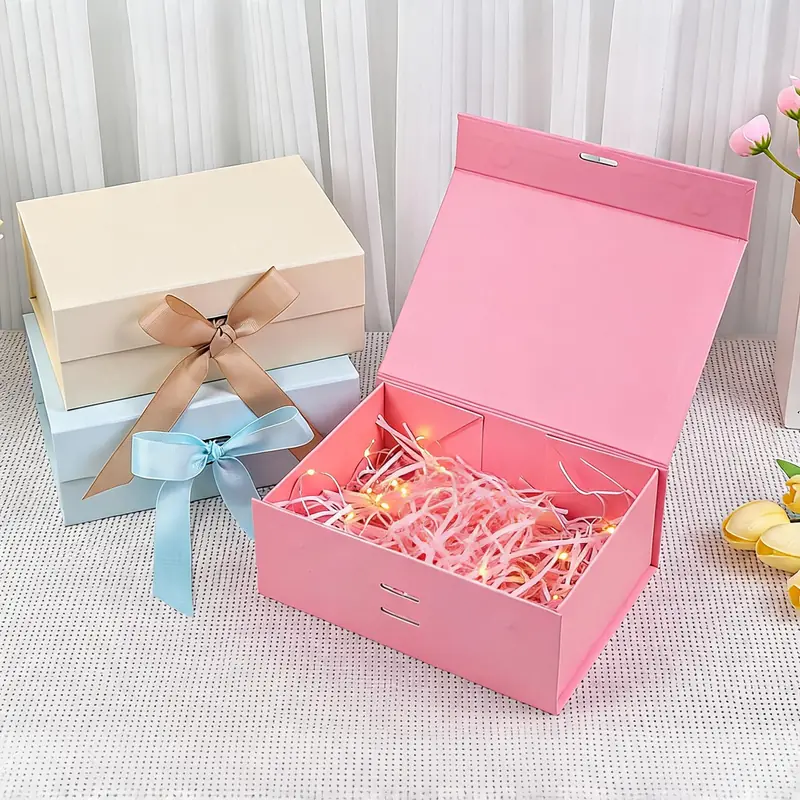 NewMade to order
Magnetic Foldable Gift Box — One-Piece Flip-Top Rigid Packaging Box
MOQ 100$1.56-3.66
EXW price
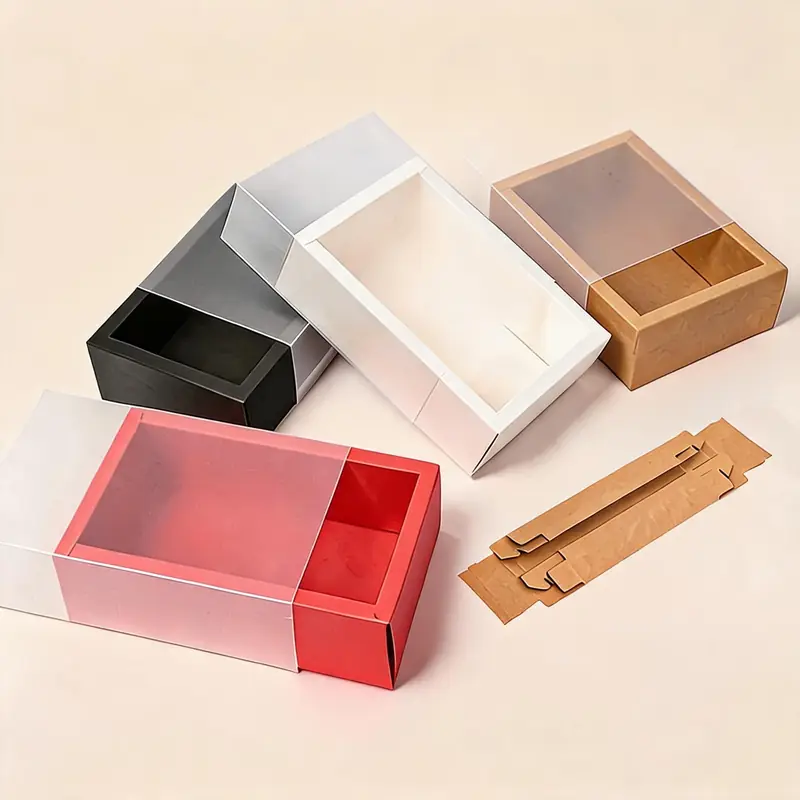 NewMade to order
Kraft Drawer Gift Box — Sliding Sleeve Box with Clear or Frosted Window
MOQ 50$0.15-0.84
EXW price
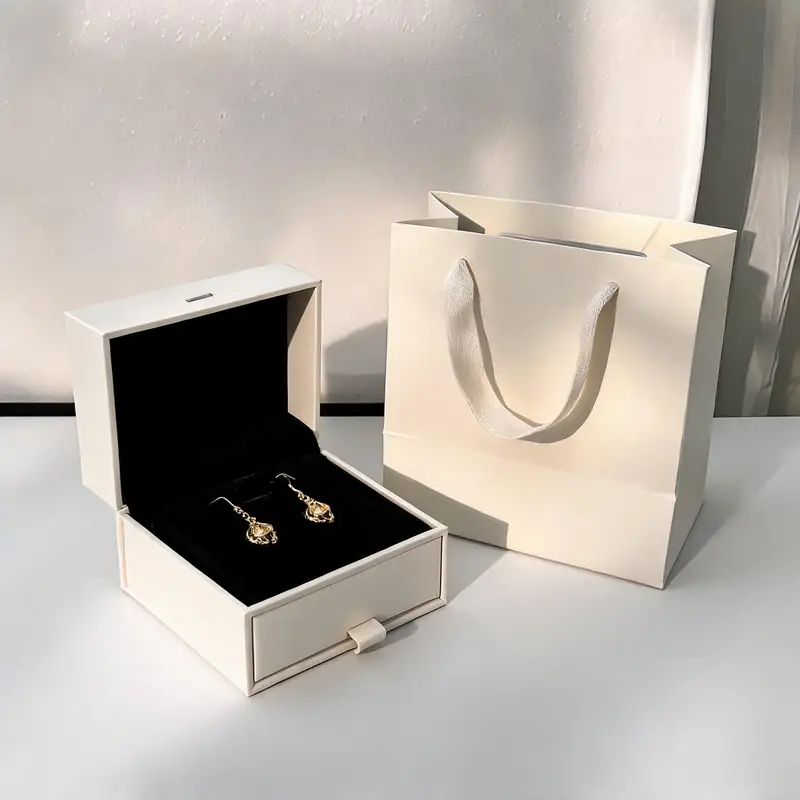 NewMade to order
Jewelry Drawer Box — Marble & Matte Finish Retail Display Packaging
MOQ 50$0.51
EXW price
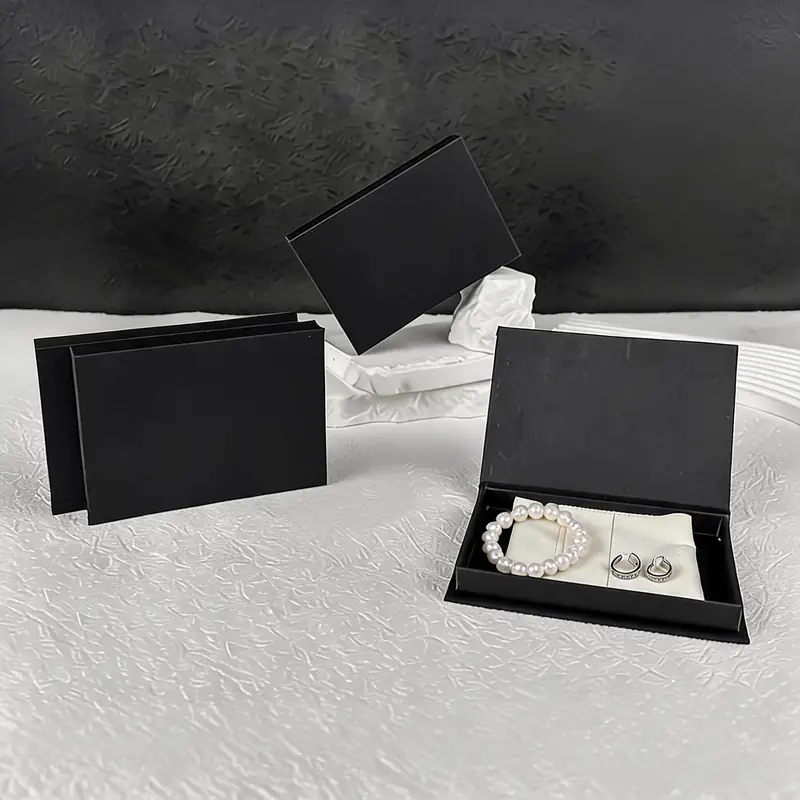 NewMade to order
Slim Book-Style Jewelry Box — Textured Paper Case
MOQ 50$0.93-1.44
EXW price
Request an insert design with your box
Send the dimensions and weight of every item, the box structure you have in mind and a reference for the look you want. We will propose the material and cavity layout, confirm fit against the stock inner size, and quote the insert die, MOQ and lead time in writing — most requests get a detailed reply within one business day.
Start your gift box insert RFQFrequently asked questions
What is a gift box insert?
A gift box insert is the shaped inner layer that holds the product in place inside the box — a die-cut EVA or PE foam tray, a velvet-flocked tray, a folded cardboard compartment, a satin-padded pad, a shaped pillow or secured loose fill. It protects the product in transit, presents it at a fixed angle and organises multi-item sets; a correct insert passes the shake test with nothing touching the box walls.
What is the best material for gift box inserts?
EVA foam for precise, premium-feeling cavities in cosmetics, electronics and jewelry; softer PE foam for heavy or fragile goods; velvet flocking on a foam or plastic tray whenever the insert is visible in photography; die-cut cardboard for eco briefs, multi-product sets and flat-shipped foldable boxes; satin pads for classic jewelry; vacuum-formed PET for one high-volume SKU; and raffia or crinkle fill for hampers with mixed contents.
What is the difference between EVA and PE foam inserts?
EVA is a dense closed-cell foam with fine, uniform cells and smooth cut walls, so cavities stay exact across a run and the surface flocks into a velvet finish cleanly. PE and EPE foams are softer and lighter with stronger shock absorption, which suits glass bottles and heavier products, but their cut edges look more functional and protective than luxurious.
Is a velvet-flocked insert real velvet?
Usually not. Flocking sprays short nylon or rayon fibres electrostatically onto an adhesive-coated foam or plastic tray, creating a velvet-like pile at lower cost and thickness than woven fabric. It looks and photographs like velvet, hides minor handling marks and is the standard premium finish for wholesale jewelry and watch trays; black, cream and burgundy are common stock colours.
How much smaller should a foam cavity be than the product?
A foam cavity is drawn about 0.5–1 mm smaller than the product on the contact faces, because the foam compresses and grips the piece. Cardboard cavities work the opposite way — about 0.5–1 mm larger, since paper board does not compress and the item must drop in and lift out. The full stack, including lid padding, still needs 5–10 mm of clearance from the box inner height.
Do gift boxes come with inserts?
Inserts are specified to the product rather than picked from stock, so box and insert are designed and quoted together: the cavity drawing is produced with the box dieline and both are checked on one white sample. Standard in-stock boxes can be ordered with their standard inserts, and branded orders use a custom cavity cut to your product.
What is the MOQ for custom gift box inserts?
Knife-die-cut inserts in EVA, PE foam, cardboard or padded board follow the branded box minimum of MOQ 100 pieces, because the tooling is an inexpensive cavity die rather than a mould. Vacuum-formed PET or PVC trays need a machined mould and suit high-volume single-SKU programs, quoted per project. Any die fee is confirmed in writing on the quote before commitment.
Do custom inserts ship flat?
Die-cut cardboard inserts ship flat and fold on receipt, which preserves the freight saving of a foldable magnetic box. Foam, flocked and vacuum-formed trays are pre-formed and ship nested in stacks; they still pack densely but partly offset the box's flat-shipping volume advantage, which matters most on air freight and warehouse-tight seasonal programs.
Can one insert hold several different products?
Yes. A shared cavity layout can accept any of several similar items, or combine a few compartments in different ways across SKUs. Reusing one insert design across a collection keeps every variant on a single knife die and is the most economical way to launch a multi-SKU range; a unique cavity for every variant is where small programs become expensive.
Can I check the insert fit before bulk production?
Yes. Plain in-stock boxes can be sampled as single pieces with standard inserts first, and a custom program then produces a white sample with the rough-cut cavity for a physical fit check, followed by the flocked or wrapped proof, in about 5–7 days. Bulk production starts only after the fit and finish are signed off.
Need these boxes, bags or ribbon?
Send your product dimensions or dieline and get a quote with MOQ and sample lead time within one business day.