Black Friday & Holiday Packaging Checklist for Small Brands
Holiday packaging checklist for small brands: five-stage tasks across all categories, artwork and proofs, MOQ 100, freight and receiving.
Small brands run holiday packaging with a small team, often one person handling buying, design, warehouse and customer service at once. In that situation the risk is not choosing the wrong box; it is skipping a step — an unchecked product dimension, an artwork file sent in the wrong format, a sea-freight window missed by a week — and discovering the problem when Black Friday is already live. A catalogue tells you what exists to buy. This checklist tells you, in order, exactly what to do and what each stage must produce before the next one starts.
The program is organised into five stages: audit and forecast, specifying the full category range, artwork and pre-production proofs, the purchase order against a countdown, and freight, receiving and launch. It deliberately covers more than gift boxes. A complete small-brand holiday range spans eight packaging categories, and most of the costly surprises happen in the ones buyers forget — the mailer that survives the courier, the pouch used for gifts with purchase, the ribbon that makes mismatched boxes read as one family.
Companion piece, not a duplicate
The planning guide for this season works through the 2026 retail calendar, the lead-time date tables and the box, bag and ribbon lineup strategy. Use it for the when and what; use this checklist for the how, stage by stage.
Read: Holiday Gift Packaging for BoutiquesStage 1 — Audit and forecast before you brief anyone
Everything quoted later depends on this stage: sizes, quantities, moments and budget. Buyers who skip it and ask for prices first end up re-quoting twice, because the numbers change as soon as real dimensions and forecasts land. Work through the list below in one sitting, and keep the result as a single sheet that travels with the RFQ.
- Pull last year's Q4 unit sales by SKU. With no prior-year data, annualise the last 90 days of run-rate and apply a seasonal uplift based on your own traffic plan rather than a generic industry figure.
- List every SKU that will be sold as a gift, each with its measured length, width and height and whether it needs an insert, foam pad or pouch.
- Count packaging stock already on hand by format, including soiled or dented units that cannot ship to a gift customer.
- Define the gift-with-purchase and loyalty-gift plan: the order value that triggers each gift, the quantity of gifts expected and the packaging each gift needs.
- Mark the moments that need distinct treatment: Black Friday and Cyber Monday online orders, boutique counter sales, corporate bulk gifting, and Hanukkah and Christmas retail.
- Audit brand assets: a vector logo file, Pantone colour codes, licensed or outlined fonts, and any seasonal artwork already approved.
- Set a budget split across hard packaging, soft packaging and accessories, and freight — freight on bulky rigid boxes is a separate line, not an afterthought.
- Name one internal owner for each stage below and a sign-off date, so no approval waits in an unattended inbox.
The most common rework
Asking for quotes before the SKU-dimension list and quantities are fixed. When either changes, box sizes, insert tooling, CBM and the quoted lead time all change together. Finish the audit sheet first, then brief suppliers.
Stage 2 — Spec the full eight-category range
A holiday range is a system, not a single hero box. The table below maps all eight categories a small brand is likely to touch, the job each one does in the season, the realistic order starting point, and whether it ships flat. Stock formats branded with your logo cover most of the range at small-batch minimums; a fully bespoke structure is reserved for the hero line that carries the brand on camera and on the counter.
| Category | Job in the holiday range | Typical starting point | Ships flat? |
|---|---|---|---|
| Rigid gift boxes — magnetic, drawer, lid-and-base | Hero gifting for online and counter; the unboxing moment | Logo on stock from 100 pcs; bespoke structure around 300–500 pcs | Foldable magnetic yes; setup boxes no |
| Jewelry boxes | Rings, earrings, pendants, watches and sets | Stock plastic-core or greyboard shells with logo from 100 pcs | Mostly no |
| Paper bags | Counter carry-out and the courier outer layer | Logo print from 100 pcs across the size range | Yes, delivered flat |
| Canvas tote bags | High-tier gift with purchase and a reusable brand impression | Logo orders from 100 pcs | Yes, soft and foldable |
| Drawstring and organza pouches | Jewelry protection, filler layer, add-on gifts | From 100 pcs | Yes, soft |
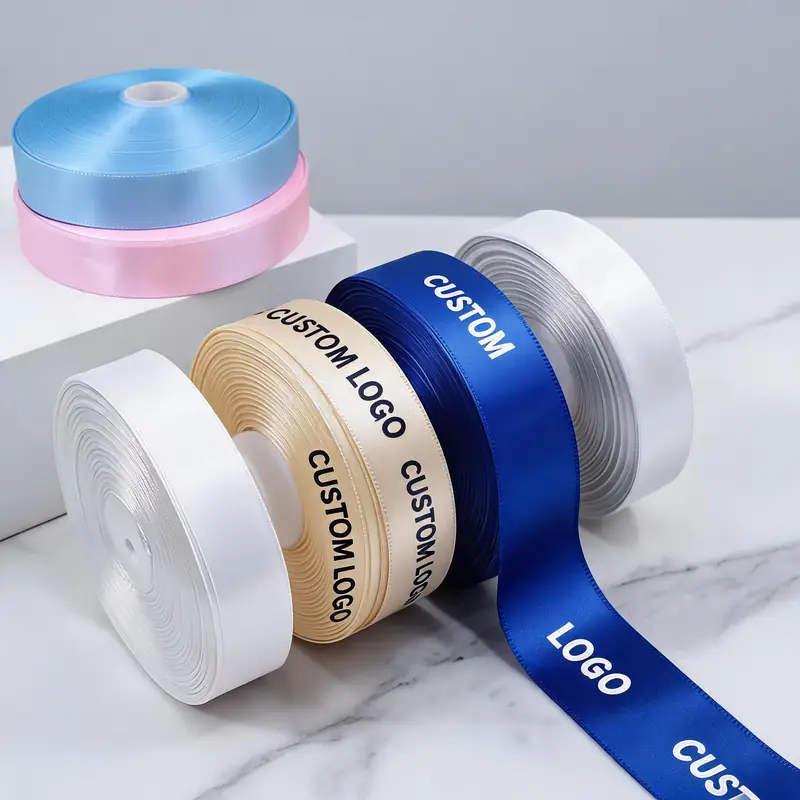
| Printed ribbon | Unifies mismatched box formats into one visual family | Custom print from one 91 m roll; widths 6–40 mm | N/A |
| Inserts and fill | Product protection, rattle control, premium presentation | Die-cut matched to the chosen box; foam tooling confirmed in writing | Yes, flat components |
| Mailer and shipping boxes | Courier-safe outer carton for e-commerce peaks | Stock sizes with logo from 100 pcs | Yes, knocked down |
Starting points are order minimums, not prices; every line is quoted against quantity, finish and destination. Flat-shipping categories collapse for transit and warehouse storage.
The minimum viable range for a first branded season is three layers: a rigid box or jewelry box for the product, a paper bag or mailer for carriage, and a pouch or ribbon for the finishing touch. Add totes, bespoke inserts and additional box formats only where the forecast justifies them. The hard-format references below cover the box, jewelry and bag layer.
Hard layer: a foldable magnetic hero box, a kraft drawer, a lid-off jewelry case and a white card paper bag — all available with logo from 100 pieces.
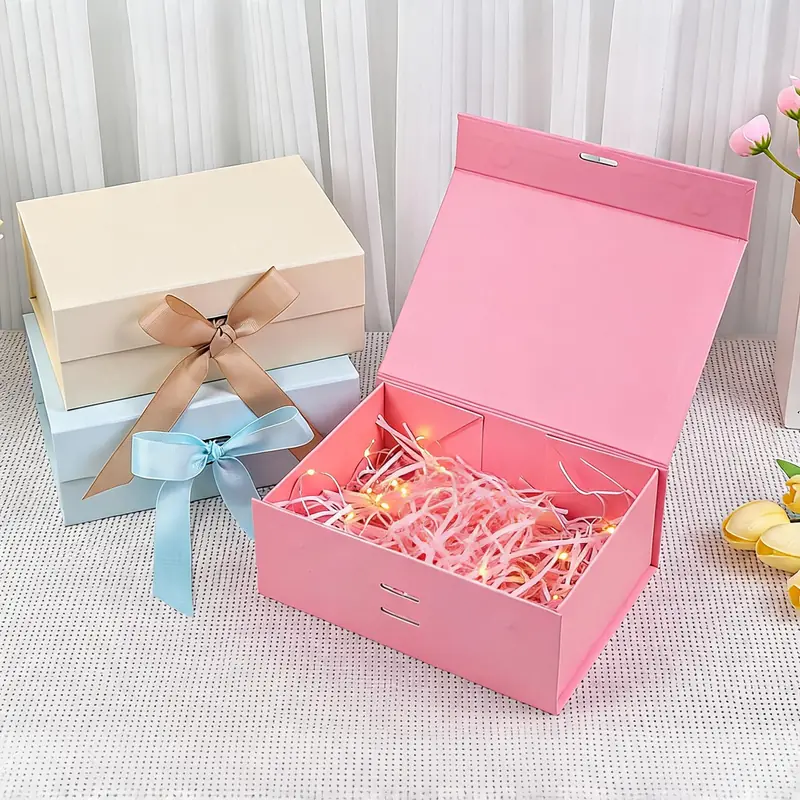 NewMade to order
Magnetic Foldable Gift Box — One-Piece Flip-Top Rigid Packaging Box
MOQ 100$1.56-3.66
EXW price
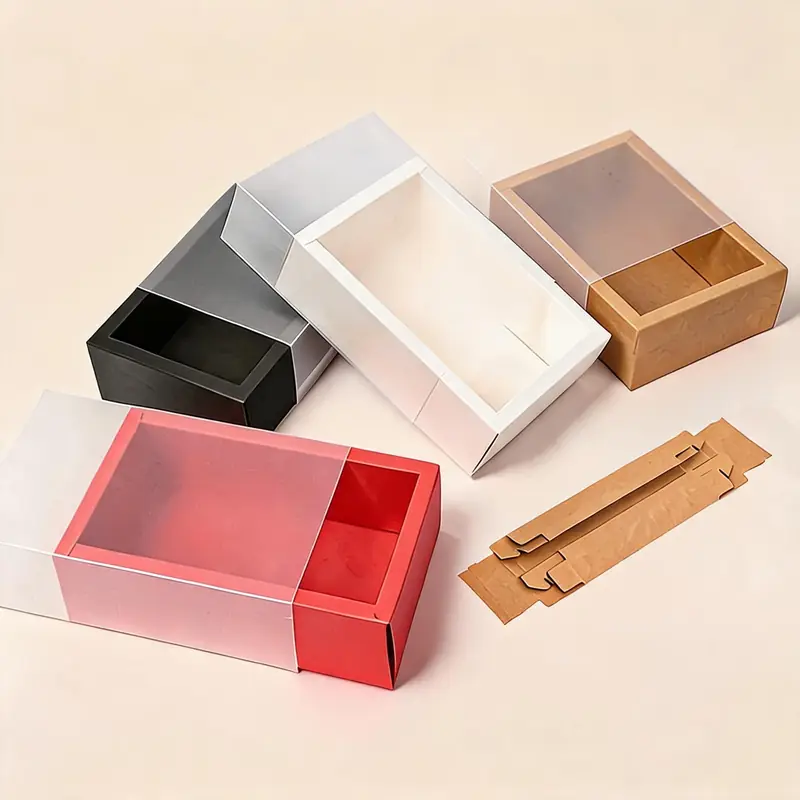 Made to order
Kraft Drawer Gift Box — Sliding Sleeve Box with Clear or Frosted Window
MOQ 100$0.15-0.84
EXW price
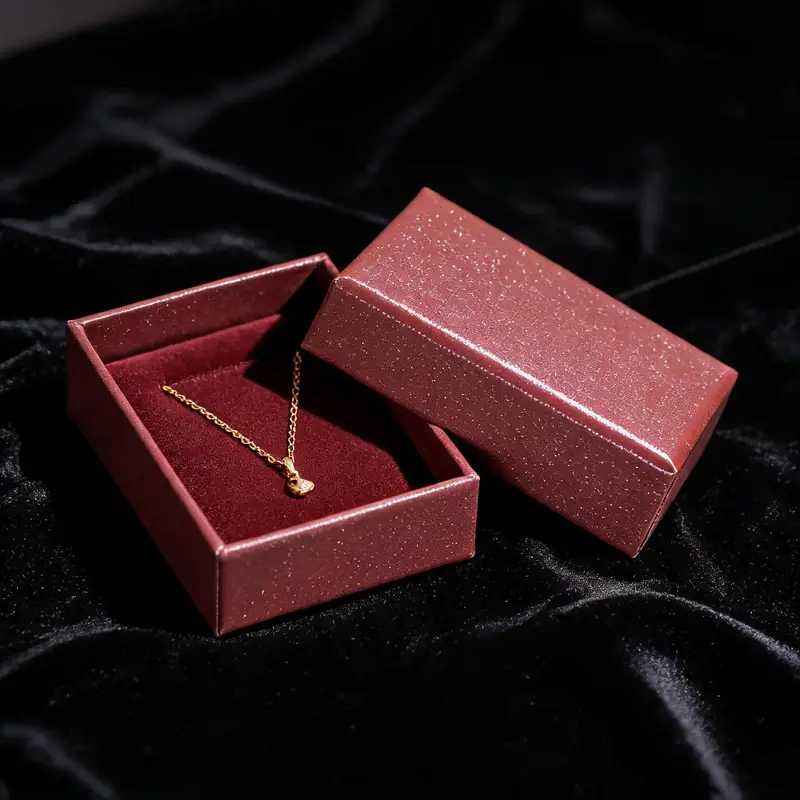 Made to order
Lid & Base Jewelry Box — Necklace, Ring & Earring Presentation Case
MOQ 500$0.22
EXW price
 Made to order
Thickened White Card Paper Gift Bag — Kraft & Laminated Shopping Tote
MOQ 100$0.08-0.56
EXW price
The soft layer does the jobs that rigid formats cannot: the tote that walks out of the store as a walking advertisement, the organza pouch that turns a small item into a complete gift, the printed ribbon that ties a mixed collection together. Because all three are soft, they add almost no volumetric weight to the consolidated shipment.
Soft layer: a 10 oz canvas tote, an organza drawstring pouch and custom-printed satin ribbon, the three finishing pieces that complete the range.
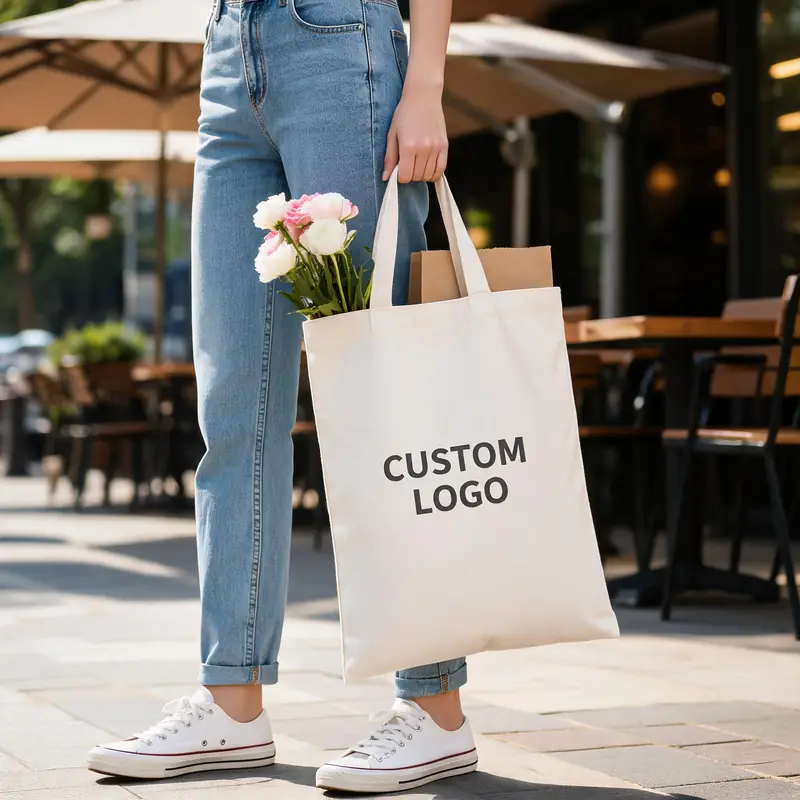

One visual system across eight categories
Pick one wrap colour, one logo treatment and one ribbon, then apply that system to every category instead of designing each format separately. The range reads as one family, and you pay for a single proofing cycle rather than eight.
Read: Custom Gift Boxes WholesaleStage 3 — Artwork, colours and pre-production proofs
Most holiday delays that get blamed on the factory actually originate in artwork. The checklist below removes the usual round-trips. Two physical approval steps follow the files: a white sample that proves structure, dimensions and insert fit, and a printed proof that proves colour and logo placement. Budget about 5–7 days for the sample-and-proof cycle and do not let bulk production start until both are approved in writing.
- Send vector artwork — AI, EPS or outlined PDF. Screenshots, Word files and low-resolution logos cannot be printed cleanly and will be sent back.
- Specify every brand colour with a Pantone code, separately for coated and uncoated stock. CMYK values alone drift noticeably on kraft and textured paper.
- Confirm logo size, position and orientation on each format's dieline, including interior-lid and ribbon repeats, not just the box lid.
- Observe bleed and the safe margin on every layout: backgrounds extend beyond the cut line while text and the logo stay inside the safe zone so nothing is trimmed off.
- Convert all text to outlines or supply the licensed fonts, and confirm you hold usage rights for any seasonal graphics.
- Approve the white sample first for structure, wall thickness, closure and the clearance gap around the product and insert.
- Approve the printed proof second for colour accuracy, foil or deboss registration and logo sharpness, then seal one approved reference sample for bulk comparison.
White sample vs printed proof
They catch different mistakes. The white sample catches dimensional errors — an insert that grips too tightly, a necklace that tangles in a too-shallow cavity. The printed proof catches visual errors. Skipping either leaves one whole class of defect unchecked until the bulk arrives.
Read: Gift Box Inserts ExplainedStage 4 — Place the PO against a countdown
The companion planning guide carries the date table built from real lead times — artwork lock, proof approval, the 15–25 day bulk window, the 2–5 week sea crossing and the 3–7 day air-freight rescue cutoff. This stage instead tracks deliverables: what must exist, and what 'done' looks like, before the purchase order is released. Work the table top to bottom; no stage should close without its artefact signed off.
| Stage | Deliverable | Done when |
|---|---|---|
| 1. Audit and forecast | SKU-and-dimension list, quantities per moment, budget split | The owner signs the forecast sheet and it is attached to the RFQ |
| 2. Range and RFQ | Spec per category, shortlisted formats, artwork status | Written quotes come back with MOQ, setup terms, lead time and freight basis |
| 3. Artwork and proof | Vector files, Pantone codes, white sample, printed proof | One sealed reference sample is in hand and both approvals are in writing |
| 4. Production | Purchase order, deposit, confirmed bulk schedule | The 15–25 day production window is booked and WIP updates are agreed |
| 5. Freight and receiving | Booking, packing list, inspection and claim plan | Goods are counted and checked against the sealed reference sample |
Each stage closes on a concrete artefact. A verbal 'looks fine' is not a sign-off — the sealed proof and written quote are the references used if a claim is ever needed.
Match the order to the MOQ tier
Stock formats and logo printing start at 100 pieces; a bespoke structural design generally needs 300–500. If the forecast does not reach the bespoke tier, brand a stock format rather than inflating quantities to chase a lower unit price — unsold holiday-specific boxes are the more expensive outcome.
Read: Packaging MOQ ExplainedLock the sea-freight window on the PO
Put the required in-warehouse date on the order and have the latest vessel departure confirmed in writing alongside the production schedule. The date table in the planning guide shows how late each milestone can start for Black Friday and Christmas.
Read: the lead-time countdown tableStage 5 — Freight, receiving and launch-day readiness
The checklist is not finished when the goods leave the factory. Freight mode, arrival inspection and the launch-day operating routine decide whether the program actually runs smoothly under peak-season pressure. Close the project with the eight tasks below.
- Confirm Incoterms and the freight booking before production finishes: sea freight takes 2–5 weeks, while air or express rescue takes 3–7 days and should be held as a documented fallback.
- Calculate CBM for the complete mixed order and ask for consolidation — boxes, paper bags, pouches and ribbon in one shipment under one set of paperwork.
- Favour flat-shipping foldable and knocked-down formats for the e-commerce peak to reduce volumetric weight and warehouse footprint.
- On arrival, count cartons against the packing list and note any discrepancy before signing the carrier's receipt.
- Run an AQL-style spot check: pull random units from several cartons, including the bottom of the pallet, and inspect print, colour, gluing, hinges and transit damage.
- Test-fit the real product with its insert inside the actual box, then add the pouch and ribbon layer exactly as a customer will receive it.
- Photograph any defect together with its carton label and report it inside the claim window stated on the order paperwork.
- Write the launch SOP: kitting steps, the order-value rules that trigger each gift with purchase, reorder thresholds for every format, and a January reuse plan for non-seasonal stock.
Build the mid-season rescue path now
In-stock lines can generally ship in around seven days, and air freight closes a 3–7 day gap, so identify which formats have stock replenishment available before the season starts. Prefer neutral, non-holiday-specific designs for the safety stock so leftovers sell through January instead of sitting until next year.
Read: How to Calculate CBMRun the whole checklist through one RFQ
The fastest way to use this checklist is to complete the Stage 1 audit sheet, then send it together with your preferred box, bag and pouch formats, logo artwork, destination and the date the goods must be in your warehouse. We build the countdown backwards from that date and confirm sizes, inserts, MOQ tiers, setup terms, consolidation and lead time in one written quote — most requests receive a detailed reply within one business day.
Start with the audit sheet
Attach SKU dimensions, quantities per moment and your in-warehouse deadline and the five-stage plan can be priced and scheduled in a single pass, including the full eight-category range in one consolidated shipment.
Start your holiday packaging RFQFrequently asked questions
When should a small brand start the Black Friday packaging process?
Start the audit and RFQ stage around ten to twelve weeks before Black Friday for a sea-freight program. The full chain — quotes, artwork, a 5–7 day sample-and-proof cycle, 15–25 days of bulk production and 2–5 weeks of sea freight — needs the runway. Programs that start later can still run on in-stock formats branded with a logo, or use air freight's 3–7 day transit as a rescue, at higher freight cost.
How do I forecast packaging quantities without last year's sales data?
Annualise the last 90 days of SKU-level run-rate, apply the uplift implied by your own marketing and traffic plan, and split the result across the sales moments from Stage 1. Keep the first order inside stock MOQ tiers where possible and identify which formats can be replenished in around seven days, so a conservative initial order can be topped up instead of guessed high.
Which packaging categories should a small-brand holiday range include?
The minimum viable range is three layers: a rigid gift box or jewelry box for the product, a paper bag or mailer for carriage, and a pouch or printed ribbon for the finish. Scale up to the full eight-category range — adding canvas totes, bespoke inserts, drawer boxes and dedicated mailers — only where the SKU forecast and gift-with-purchase plan justify each line.
What artwork files do I need for custom holiday packaging?
Vector files in AI, EPS or outlined PDF, with Pantone codes for every brand colour, logo placement confirmed on each dieline, correct bleed and safe margins, and text converted to outlines or supplied with licensed fonts. Non-vector files such as screenshots or Word documents cannot be printed reliably and will be returned for replacement.
What is the difference between a white sample and a printed proof?
A white sample is an unbranded physical unit that proves structure, dimensions, closure and how the product fits the insert. A printed proof is a branded unit that proves colour, foil or deboss registration and logo placement. Both need written approval before bulk production; together they take about 5–7 days and catch two different classes of error.
What MOQ applies to a small-brand holiday packaging order?
In-stock boxes, jewelry cases, paper bags, totes and pouches with a printed or foil logo start at 100 pieces per format. A fully bespoke structural design generally needs 300–500 pieces, and a brand-new injection mould sits at 1,000–3,000 pieces per size plus a mould fee. Custom ribbon prints from a single 91 metre roll. Most small-brand programs therefore brand stock formats rather than tooling new structures.
How should I inspect a bulk shipment when it arrives?
First count cartons against the packing list before signing. Then pull a random sample from multiple cartons for an AQL-style check of print, colour, gluing, hinges and damage, including cartons at the bottom of the pallet. Finally test-fit the real product, insert, pouch and ribbon exactly as the customer receives them, and photograph any defect with its carton label inside the documented claim window.
What if a line is delayed or stock runs out mid-season?
Two fallbacks should be prepared before launch: in-stock formats that can replenish in around seven days, and air or express freight that closes a 3–7 day gap. For safety stock choose neutral designs without holiday-specific printing, so the same boxes, bags and pouches keep selling after Christmas instead of waiting eleven months for the next season.
Need these boxes, bags or ribbon?
Send your product dimensions or dieline and get a quote with MOQ and sample lead time within one business day.