Plastic Jewelry Boxes Wholesale: Plastic-Core Cases for Rings, Pendants and Earrings
Plastic jewelry boxes wholesale: injection-moulded PS/ABS plastic-core cases in velvet, PU or paper wraps, with LED options, MOQ 100 and mould rules.
Buyers searching for plastic jewelry boxes wholesale are usually picturing the same object: a crisp-edged velvet ring box that snaps shut on an integral hinge, a PU leather pendant case with a spotlight inside, or a stack of flocked earring cases on a jeweller's counter. What reads as velvet or leather on the outside is almost always an injection-moulded PS or ABS plastic shell underneath — the plastic core that makes seamless sharp edges, repeat-precise cavities, integral hinges and built-in LED lights possible. This guide explains what a plastic-core jewelry box is, how it compares with greyboard and MDF construction, how to choose formats by jewelry type, which finishes go over the shell, and the MOQ, sampling and tooling rules behind a wholesale order.
What is a plastic-core jewelry box?
A plastic-core jewelry box is built on a rigid shell injection-moulded from polystyrene (PS) or ABS resin, usually in two halves — a base and a hinged or separate lid — and then dressed like a luxury box. The shell is wrapped or coated in one of several finishes: electrostatically flocked velvet, smooth or brushed PU leather, leather-grain textured paper, or a hard gloss spray coating. Inside, a die-cut foam or flocked velvet insert locates the piece, matched to the exact format: a foam roll for a ring, a hook or pad for a pendant, a double slot for earrings, a shaped pillow for a watch. The plastic is never meant to be visible; it is the engineered skeleton that the buyer experiences only through perfect edges and a satisfying shut.
The construction explains why this category dominates jewelry counters. Injection moulding reproduces the same cavity, wall thickness and hinge point on every unit, so hundreds of ring cases stack, close and present identically. Corners are seamless rather than folded, the hinge is part of the shell rather than a cloth strip that can wear, and the lid has real internal depth for an LED module, battery and switch. Stock shells — public moulds, in trade language — already cover the standard ring, pendant, bangle and set formats, which is what lets small branded orders run without any mould fee.
Plastic core vs greyboard vs MDF
Rigid jewelry boxes are built on one of three cores, and the core decides what the box can do structurally and commercially. Paper-wrapped greyboard is the bespoke route, injection plastic is the precision and hardware route, and MDF density board sits between the two. No prices are fixed in this guide — each line is quoted against quantity and finish — but the tooling logic is stable.
| Core | Edges and hinge | LED and hardware | Weight and feel | Tooling and MOQ | Best for |
|---|---|---|---|---|---|
| Injection PS/ABS plastic | Seamless sharp edges; integral hinge moulded in | Recesses, bosses and LED modules moulded into the lid | Light, precise, identical unit to unit | Stock shells brand from 100 pcs; a new mould runs 1,000–3,000 pcs per size plus a mould fee | Velvet ring cases, LED and PU lines, counter retail |
| Greyboard 1.5–2 mm, paper-wrapped | Small corner radius of about 0.5–1 mm; hinge is a separate wrapped strip | No internal depth for lighting or wiring | Lightest; the most flexible for bespoke sizes | Cutting die only; bespoke structures from 300–500 pcs | Custom dielines, branded gift boxes, multi-piece sets |
| MDF density board, CNC-cut | Sharp machined edges; solid, rattle-free feel | Can be machined to house hardware | Heaviest; strong premium heft | No mould fee; CNC work from low hundreds | Weighty premium cases, mid-volume custom programs |
All three cores accept foil, deboss and print; the differences are structural, not decorative.
Choose a plastic-core case for the classic velvet or PU counter vocabulary — seamless edges, a hinged snap, optional lighting — working from a stock shell with your own logo and wrap. Choose greyboard for bespoke dielines, unusual proportions or flat-shipping folding formats. Choose MDF when weight and machined sharpness matter but the quantity does not justify an injection mould.
Choosing a plastic jewelry box by jewelry type
Format follows the piece, and the plastic-core range has a named format for every jewelry category. The matching logic is the same one used in our jewelry box types guide: rings stand upright in a foam roll or slot, pendants hang on a hook or lie on a padded pad, earrings sit on a card or double slot, bangles and bracelets need a deeper round cavity, and watches travel on a shaped pillow.
- Rings and pair rings: compact flocked cases in single and double widths; an LED ring case adds a spotlight that fires on opening for premium and proposal lines.
- Earrings and studs: small hinged or lid-off flocked cases with a double slot or earring card, sized to stay pocket-light for e-commerce.
- Pendants and necklaces: pendant-format cases with a hook or padded pad so the chain cannot tangle; deeper lids accommodate a pendant on a card.
- Bangles and bracelets: round or cushion-profile shells with a deep velvet cavity and, on premium lines, interior lighting.
- Watches: flip-top PU cases on a shaped pillow sized for most 38–46 mm watch cases, with room for a warranty card.
- Jewelry sets: small and large set formats combining several pieces in one flocked tray, used for coordinated gifting and counter bundles.
Two in-stock lines show how the format system works in practice. The LED-lighted brushed-PU range (Item LSD) runs seven formats — ring, pair ring, pendant, bangle, bracelet, small set and large set — in four colours, champagne gold, silver grey, navy and burgundy, with built-in spotlights and a velvet lining; in-stock variants can leave within about seven days. The PU watch and jewelry flip-top line runs 48 in-stock styles, including octagonal, square-edge, round-corner, curved-top, zip and set versions, every one of them accepting a hot-stamped lid or lining logo.
Finishes over the plastic core
Because the shell is hidden, the wrap and the insert carry the entire perceived value — and they are where small-batch customisation happens without touching the mould.
- Flocked velvet: short nylon or rayon fibres sprayed electrostatically onto an adhesive-coated shell for the classic matte, jewellery-counter pile; hides minor handling marks and photographs as deep, even colour.
- PU leather: smooth or brushed polyurethane faux leather with stitched edges, soft to the touch and especially clean under debossed logos — the standard finish for lighted and watch cases.
- Leather-grain and textured paper: the middle tier, lighter than PU, taking foil and full-colour print with sharp detail.
- Gloss or spray coating: a hard, mirror-like piano finish in solid colours for modern and tech-adjacent brands.
- Branding and lining: gold, silver and rose-gold hot foil, debossing and print on the lid or interior, plus custom flock colours on larger runs; matching velvet inserts are die-cut to the piece.
Matching the insert to the piece
The foam roll, slot, hook or velvet pillow inside a plastic-core case is specified to the exact piece, not chosen from a catalogue. Our insert guide compares flocked trays, EVA and PE foam, satin pads and vacuum-formed cavities, including the 0.5–1 mm grip allowance that keeps a ring or pendant motionless in transit.
Read: Gift Box Inserts ExplainedThe full four-format picture
Plastic-core cases sit alongside lid-off, drawer and book-style paper boxes in the jewelry box range. Our types guide maps all four formats to ring, necklace, bracelet, watch and set briefs with size ranges and the same three-core construction framework used here.
Read: 4 Jewelry Box Types and Their InsertsWhy LED lights and hinges only work on plastic or MDF cores
A greyboard box is laminated paper board one to two millimetres thick. It has no internal depth to hold a battery, wiring, switch and LED module, and its hinge is a paper or cloth strip that flexes rather than locates — there is no stock greyboard LED category for that reason. An injection shell is different: recesses, mounting bosses, snap fits and an integral living hinge are all moulded in the same cycle, so the lighting kit drops into a purpose-built cavity and the lid opens and closes thousands of times without wear. MDF can be CNC-machined to house the same hardware, which makes it the alternative when a wood-weight, non-plastic case needs lighting, though it costs more than a stock plastic shell at small quantities.
The LED itself is a small lid spotlight that switches on as the case opens, powered by a cell housed in the moulded lid cavity. It is the most effective upgrade for proposal ring boxes, pendant hero pieces and counter display because it controls the lighting of the reveal photograph instead of relying on store ambience.
MOQ, sampling and lead time
Three quantity tiers govern wholesale plastic jewelry boxes, and the key point is that most branded orders never touch a mould. Unbranded in-stock plastic-core cases, including the LED-lighted PU range, start at 100 pieces, and single-piece samples can be ordered first to check format and insert quality. Adding a foil logo, deboss, print or a wrap change on a stock shell also starts around 100 pieces, because the work is a plate, block or wrapping operation on an existing shell. Opening a brand-new injection-moulded shell is a different proposition: a mould fee applies and runs generally start at 1,000–3,000 pieces per size, so boutique programs customise a public mould rather than tool a private one. Any mould fee is confirmed in writing on the quote before commitment.
Sampling follows the standard rigid-box sequence: a plain stock unit first, then a white sample and a printed or foil-stamped proof at about 5–7 days, with bulk production running roughly 15–25 days after sign-off. Pure stock orders move faster — the LED line can ship in around seven days. Inserts are specified with the box: a die-cut velvet or foam cavity is cut to the piece dimensions and checked on the same sample; the full insert vocabulary is mapped in our gift box inserts guide.
Designing a wider packaging range
Plastic-core cases can be consolidated with paper-wrapped lid-off boxes, pouches, paper bags and printed ribbon into one shipment and one proforma invoice. The custom gift boxes hub lays out the customisation tiers, finishes and order timeline for the paper-rigid side of the range.
Read: Custom Gift Boxes WholesaleThe LED-lighted brushed-PU cases and the 48-style PU flip-top line are plastic-core constructions; the jewelry drawer and lid-off cases are paper-wrapped rigid alternatives for the same ring, pendant and earring briefs.
 NewMade to order
LED Lighted Brushed PU Leather Jewellery Box — Ring, Pendant, Bangle, Bracelet & Set Cases
MOQ 100$1.29-5.12
EXW price
 Made to order
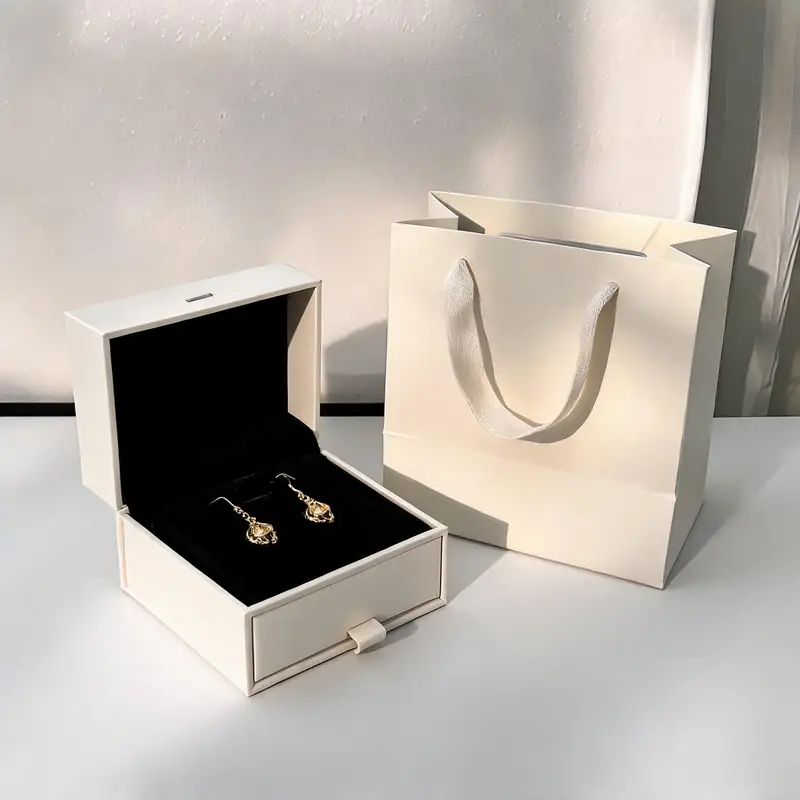
PU Leather Watch & Jewelry Gift Box — Flip-Top Presentation Case
MOQ 100$0.85-4.14
EXW price
 Made to order
Jewelry Drawer Box — Marble & Matte Finish Retail Display Packaging
MOQ 100$0.51
EXW price
 Made to order
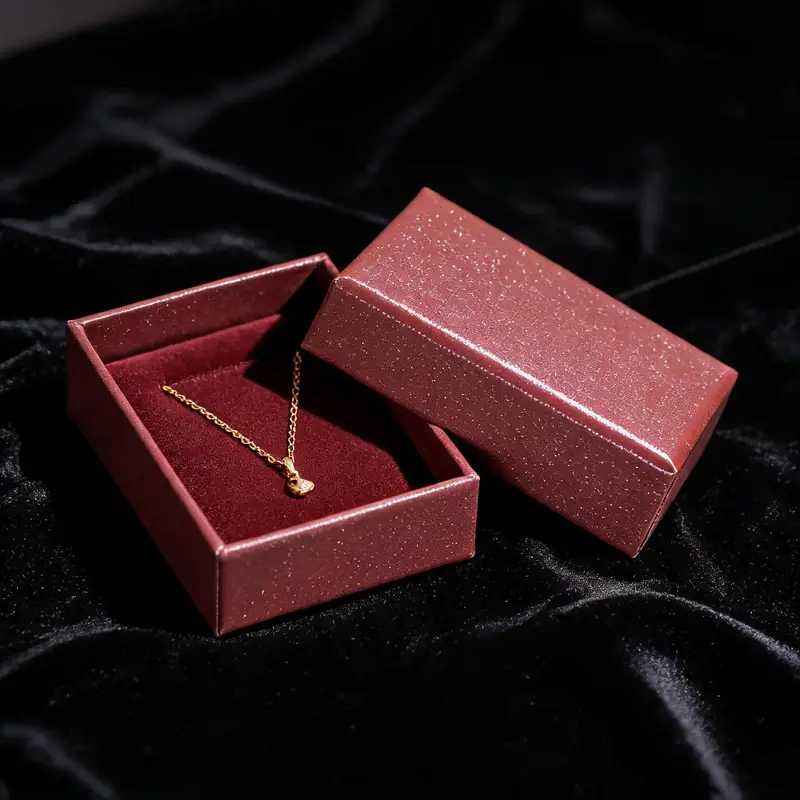
Lid & Base Jewelry Box — Necklace, Ring & Earring Presentation Case
MOQ 500$0.22
EXW price
Request plastic jewelry boxes in one RFQ
Send the piece dimensions and jewelry type, preferred shell format and finish, LED yes or no, logo artwork, quantity and destination. We will recommend a stock shell or a custom route, confirm the insert cavity and quote MOQ, any mould fee and lead time in writing — most requests receive a detailed reply within one business day.
Start your plastic jewelry box RFQFrequently asked questions
What is a plastic jewelry box?
A plastic jewelry box is built on an injection-moulded PS or ABS shell, then wrapped in flocked velvet, PU leather, leather-grain paper or a gloss coating, and fitted with a die-cut foam or velvet insert. The plastic core gives seamless edges, an integral hinge and the internal depth for LED lights, while the wrap provides the luxury look and feel.
Are velvet and flocked jewelry boxes made of plastic?
Most wholesale velvet and flocked ring, earring and pendant boxes are. Flocking is a finish — short fibres sprayed electrostatically onto an adhesive-coated surface — and the surface underneath is usually an injection-moulded plastic shell. Woven velvet over greyboard exists at the premium end, but the standard counter-retail flocked case is a plastic-core box.
What is the difference between plastic and cardboard jewelry boxes?
Plastic-core boxes offer seamless sharp edges, an integral long-life hinge, unit-to-unit precision and the option of built-in LED lighting, and they brand from stock shells at 100 pieces. Cardboard greyboard boxes use 1.5–2 mm wrapped board with a small corner radius and a separate hinge strip; they cannot house lighting but allow bespoke sizes and flat-shipping folding structures, with custom runs starting around 300–500 pieces.
Can plastic jewelry boxes come with LED lights?
Yes. LED spotlights are moulded into the lid of plastic-core cases such as the brushed-PU LSD range, switching on when the box opens. The battery, wiring and switch occupy recesses moulded into the shell, which is why lighted boxes are not available in thin greyboard construction; MDF can be CNC-machined for the same hardware as a heavier alternative.
What is the MOQ for wholesale plastic jewelry boxes?
Unbranded in-stock plastic-core cases, including the LED-lighted PU range, start at 100 pieces, and custom foil, deboss, print or wrap work on a stock shell also starts around 100 pieces. A brand-new injection-moulded shell needs a mould and generally starts at 1,000–3,000 pieces per size, so most small and mid-size programs customise a stock shell instead.
Can I brand stock plastic-core boxes with my own logo?
Yes. Hot-foil stamping in gold, silver or rose gold, debossing and printing can be applied to the lid or interior lining of every stock shell, including all 48 styles in the PU watch line. Wrap and flock-colour changes are possible on larger runs, and the velvet or foam insert can be die-cut to your exact piece at the same time.
Do I have to pay for an injection mould?
Not for a stock-shell order. Public moulds already cover the standard ring, pair-ring, pendant, bangle, bracelet, watch and set formats, and branding runs on those shells from 100 pieces with no mould fee. A mould fee applies only when you need a proprietary shape or size, which typically means 1,000–3,000 pieces per size; the fee is always confirmed in writing on the quote first.
Can I order samples, and how long does production take?
Yes. Stock lines can be sampled as single pieces, and custom programs move to a white sample plus a foil-stamped proof in about 5–7 days. Bulk production runs roughly 15–25 days after sign-off depending on quantity and finish, while pure in-stock orders such as the LED range can ship in around seven days.
Need these boxes, bags or ribbon?
Send your product dimensions or dieline and get a quote with MOQ and sample lead time within one business day.