Paper Bag Handles Explained: Twisted Cord, Flat Rope and Die-Cut
Twisted cord, flat rope or die-cut handles? How each paper bag handle looks, feels and carries, plus reinforcement options and how to match the handle to your product weight.
The handle is the most under-specified part of a paper bag. It is the only part a customer holds, it decides how the bag feels in the hand for the walk from shop to car, and it is the first thing that fails when a bag is overloaded. Three handle styles do almost all the work in retail packaging — twisted paper cord, flat paper rope and die-cut punch handles — plus optional ribbon or cotton upgrades for gift lines. This guide compares how each looks, carries and costs, and how to match one to the weight of your product.
The three common paper bag handles
| Handle | Look and feel | Typical use | Relative cost |
|---|---|---|---|
| Twisted paper cord | Classic twisted strands; firm, slightly rustic | Everyday retail, takeaway, event bags | Standard / low |
| Flat paper rope (flat tape) | Wide, soft band that sits flat in the hand | Boutiques, cosmetics, apparel | Mid |
| Die-cut (punch handle) | Clean slot or oval cut into the folded top; no added parts | Light retail, pharmacy, documents, food | Lowest |
| Ribbon / cotton cord (upgrade) | Soft textile pull; distinctly gift-like | Luxury retail and gift packaging | Higher |
Exact load depends on board weight, bag width and reinforcement; treat the notes below as relative.
Twisted paper cord: the retail default
Twisted cord handles are made from twisted paper strands bonded into a rope and glued between the bag wall and a reinforcing patch inside the top fold. They are the default for a reason: they are inexpensive, available in white and kraft and a wide colour range, and they fold flat for pallet-efficient shipping. The twisted shape grips well in the hand and carries more than its thickness suggests, though a heavily loaded narrow cord can start to feel sharp on the fingers on a long walk.
Choose twisted cord when the bag is general retail or event merchandise and the contents are a few kilograms at most — clothing, a pair of shoes boxed in the bag, groceries or trade-show giveaways. It is also the safest pick for price-sensitive orders where the logo and board quality matter more than a luxury hand feel.
Flat paper rope: the boutique upgrade
Flat rope — sometimes called flat tape or flat cord — is a wide paper band rather than a twisted rope. The wider contact area spreads the load across the palm, so the same weight feels noticeably lighter and never cuts in. Visually it reads softer and more considered than twisted cord, which is why cosmetics brands, jewellers and apparel boutiques tend to specify it, often colour-matched to the bag or contrasted in black or white.
Flat handles cost a little more per bag and are usually specified on heavier white-card or coated stock rather than thin kraft. If your customer walks any distance with the purchase, or the bag is part of a premium unboxing, the upgrade is small money for a clear step up in perceived quality.
Die-cut handles: minimal and lightweight
A die-cut handle is simply a slot, oval or rounded rectangle punched through the folded top of the bag, often with the cut edge reinforced by the doubled board. There are no added components, so the bag stays completely flat, costs the least to produce, and carries a clean, modern look with nothing attached to the artwork. Reinforced die-cuts can also take a surprising amount of pull because the load runs through the whole folded top rather than a glued patch.
The limitation is comfort and weight: fingers press directly against the board edge, so die-cuts suit items carried for a short time — pharmacy and counter retail, documents, maps, light food orders, sample bags. For heavy or bulky products a cord or flat rope is the better call.
Reinforcement: what actually holds the weight
Handle type alone does not determine load capacity — attachment does. Cord and flat-rope handles are anchored with an internal reinforcing patch (a stiff card or laminated tab glued under the top fold), which spreads the pull so the handle cannot tear straight through the paper. Upgrades include thicker or double patches and metal or plastic eyelets at the exit points. As a rough guide, a standard twisted handle on ordinary retail board is comfortable at a couple of kilograms; a reinforced patch on heavier board roughly doubles that. Because the numbers depend on board weight and bag width, the honest way to confirm capacity is to load a finished sample and lift.
Board weight does the heavy lifting
Moving from thin kraft to heavier white-card stock improves handle security as much as changing handle style. Our GSM guide explains paper weights in plain terms.
Read: what GSM means in packagingMatching handle to product
| What goes in the bag | Recommended handle | Notes |
|---|---|---|
| Light retail, documents, food-to-go | Die-cut | Lowest cost; flat for bulk storage |
| Apparel, shoes, everyday retail | Twisted cord | Best balance of price and strength |
| Cosmetics, jewelry, candles | Flat rope, colour-matched | Soft hand feel suits premium positioning |
| Gift sets and luxury lines | Ribbon or cotton cord | Gift-like pull; pairs with foil-finished bags |
| Heavy or multiple items | Twisted or flat handle + reinforced patch | Specify reinforcement, not just the handle style |
Custom options for branded bags
All three handles can be ordered to match custom branding. Cord and flat rope come in a wide colour range, so most brands either match the bag for a tonal look or contrast it (black on white, white on kraft). Logos are normally printed or foil-stamped on the bag body rather than on the handle itself, where the twisted or folded surface would not print cleanly. On our own lines, custom paper bags with a choice of twisted cord, flat rope or die-cut handles are available on stock formats with MOQ from 50 pcs, and samples with your selected handle arrive with the white sample and printed proof in about 5–7 days.
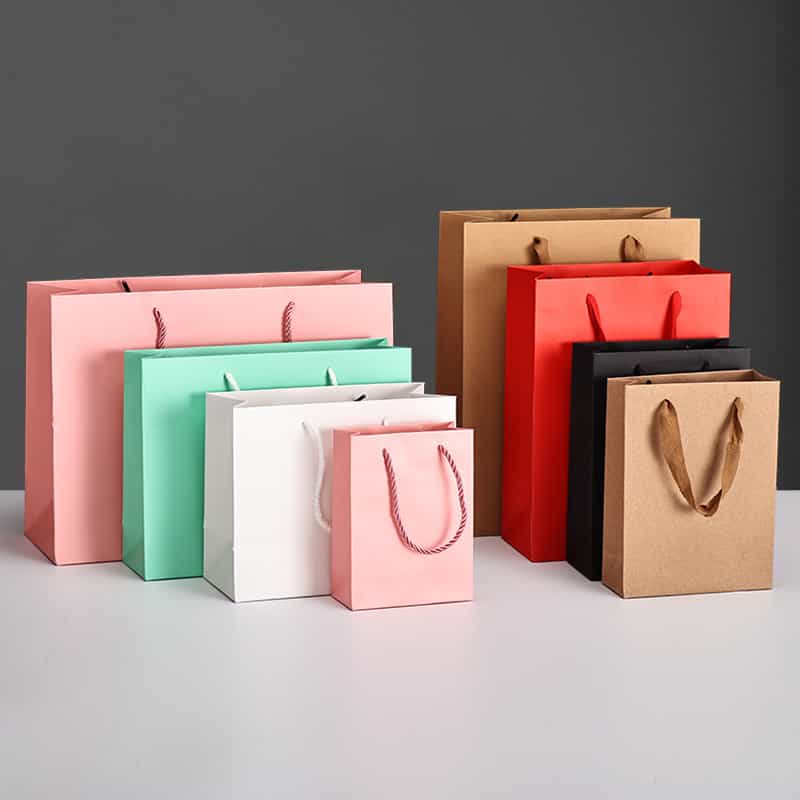
Stock paper-bag formats, ready for custom print with your choice of handle. Browse the full paper bags category.
 NewMade to order
Thickened White Card Paper Gift Bag — Kraft & Laminated Shopping Tote
MOQ 100$0.08-0.56
EXW price
 NewMade to order
Custom-Logo Jewellery Paper Gift Bag — Pearl & Specialty Retail Shopping Bag
MOQ 100$0.15-0.53
EXW price
 NewMade to order
Seamless Luxury Paper Gift Bag, Custom-Made to Artwork — Pearl Paper Shopping Tote
MOQ 100$0.55
EXW price
 NewMade to order
Cross-Border Premium Paper Gift Bag with Logo — Pearl, Black & Kraft Shopping Tote
MOQ 100$0.15-0.53
EXW price
Frequently asked questions
Which paper bag handle is the strongest?
A flat paper-rope handle or twisted cord fitted with a reinforced internal patch is the strongest common option; flat rope also carries more comfortably because the wide band spreads the load. Die-cut handles are reinforced by the doubled board and handle light loads well, but board edge pressure makes them less comfortable for heavy items. Confirm real capacity by lifting a loaded sample.
Can I print my logo on the bag handles?
Logos are normally printed or foil-stamped on the bag body, not on twisted or folded handles, whose uneven surface does not print cleanly. For branded cohesion, colour-match the handles to the artwork or use a deliberate contrast; metal or plastic eyelets can add a premium accent at the handle exit points.
Are die-cut handles any good?
Yes, for the right job. Die-cut handles are the lowest-cost option, ship completely flat and suit short-carry, lightweight items like counter retail, documents and food orders. They are not comfortable or secure for heavy, bulky loads, where a reinforced cord or flat rope is preferable.
Do different handle types change the price much?
Die-cut handles add the least cost, twisted paper cord is the standard retail price point, and flat paper rope sits a step above. Ribbon or cotton cord upgrades cost more again. The board weight and any reinforcing patches often affect price as much as the handle style, so compare complete specifications rather than handles alone.
How do I stop handles tearing out of the bag?
Specify an internal reinforcing patch under the top fold, add eyelets at the handle exits for heavy loads, and choose board weight suited to the product rather than the lightest stock. Then test a finished sample loaded to the real order weight before approving bulk production.
Need these boxes, bags or ribbon?
Send your product dimensions or dieline and get a quote with MOQ and sample lead time within one business day.